
By pairing learners with expert teachers in one-to-one settings, Cicero aims to make the kind of mentorship students remember for years more accessible to modern families.
Most people can name at least one teacher who stayed with them long after a class ended.
It may have been the teacher who noticed a hidden talent, encouraged a struggling student, or sparked an interest that shaped an entire career. Years later, the details of the coursework may fade, but the relationship often remains clear. Great teachers leave an impression that extends far beyond academics.
That belief sits at the center of Cicero, a personalized learning platform founded by former journalist and entrepreneur Paul Bennett. While many conversations in education focus on curriculum, technology, or test scores, Cicero starts with a different premise. The teacher-student relationship is the heart of learning.
A Personal Search for a Better Way to Learn
Bennett’s path to education began with his family’s experience. A longtime traveler, entrepreneur, and former journalist whose work appeared in publications including National Geographic and Wired, he spent a decade sailing around the world with his family.
The adventure raised an important question. How could children receive a meaningful education while living a life untethered from a traditional classroom?
The challenge was particularly relevant for families interested in homeschooling and alternative learning models. Many wanted flexibility without sacrificing educational quality or personal guidance.
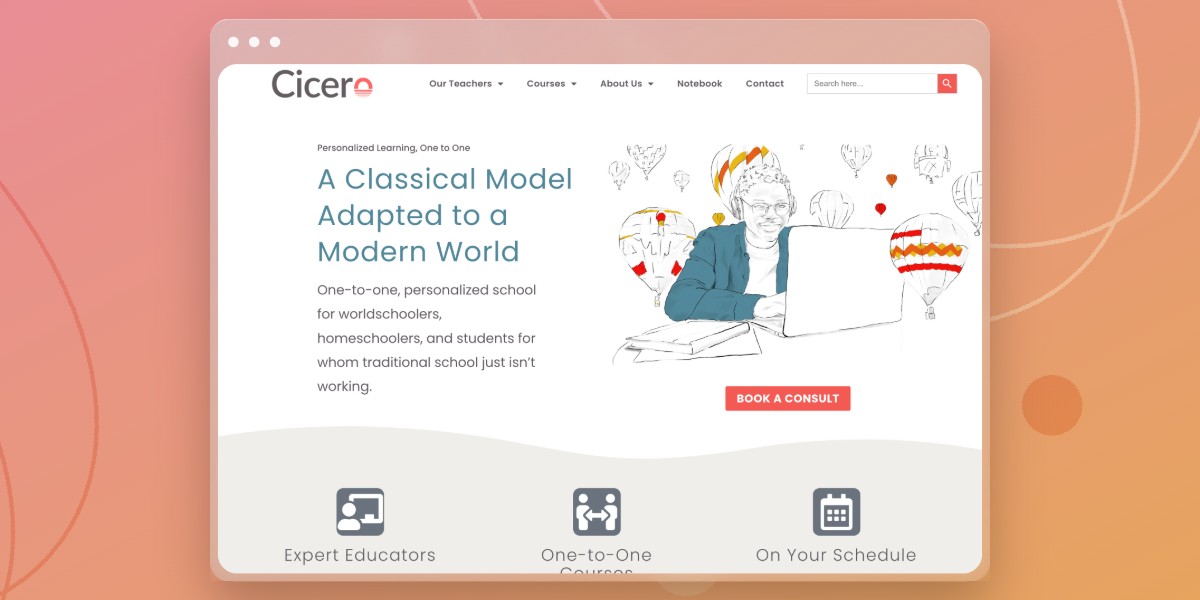
That experience eventually led Bennett to create Cicero, a public benefit corporation that connects middle- and high-school learners with private teachers for one-to-one remote learning.
Why One Teacher Can Make Such a Difference
The idea behind Cicero reflects a long-standing educational principle. Students often learn best when a teacher has the time and space to understand them as individuals.
Research on one-to-one learning, including the well-known Bloom’s 2 Sigma findings, suggests that individualized instruction can produce substantially stronger academic outcomes than conventional classroom settings. When teachers can adapt lessons to a learner’s strengths, interests, challenges, and pace, learning becomes far more personal.
For Cicero, that personalization begins with the teacher.
Rather than positioning educators as generic tutors focused on completing assignments, the platform emphasizes expert teachers who act as mentors and guides. The goal is not simply to help a learner finish a course. It is to build an educational relationship grounded in trust, curiosity, and meaningful engagement.
That distinction matters because students rarely fit an average profile. A teenager fascinated by marine biology may need a different approach than one captivated by literature, entrepreneurship, or world history. One-to-one learning allows teachers to design courses around the learner rather than asking the learner to adapt to a standardized model.
Learning Built Around Real Lives
The model has found particular appeal among families pursuing homeschooling and worldschooling lifestyles.
For parents who travel frequently, work remotely, or seek alternatives to traditional schools, flexibility is often only part of the equation.
Many are also seeking deeper educational experiences that foster intellectual curiosity and independent thinking.
Cicero’s approach reflects those priorities. Lessons take place remotely, allowing learners to connect with teachers regardless of geography, while maintaining the consistency of an ongoing mentor relationship.
For families, that relationship can provide something increasingly difficult to find in large educational settings. A teacher who truly knows the learner.
The Lasting Value of Mentorship
Educational technology continues to expand, offering new ways to access information from virtually anywhere. Yet Bennett believes the most important element of learning remains deeply human.
A great teacher can challenge assumptions, build confidence, encourage questions, and help a learner recognize abilities they may not yet see in themselves.
Those moments often become the experiences students remember most.
As Cicero grows, Bennett’s vision remains focused on making that kind of mentorship accessible to more families. The platform’s mission is rooted in a simple but enduring idea. While lessons matter, relationships are often what make learning stick for a lifetime.