No-Fee Banking in Canada Exists, So Why Are Millions Still Paying for Their Chequing Account?

By Audrey Denise Cachuela

Most Canadians pay a monthly fee for their chequing account without giving it much thought. Institutions like Innovation Federal Credit Union have built their model around the idea that it shouldn’t cost money just to hold money, and a growing number of Canadians are starting to agree. The market for no-fee chequing accounts in Canada has expanded considerably over the past few years, and the options are better than most people realize.

Why Canadians Keep Paying Fees They Don’t Have to

Most people open a bank account when they’re young, usually at whichever institution their parents used, and keep that account indefinitely. Fees renew automatically, and nobody revisits them. Switching feels like a project, and the monthly cost is easy enough to absorb without thinking too hard about it.

Traditional banks bundled monthly fees with their services for decades, packaging branch access, transaction processing, and customer support all together. That arrangement made more sense when visiting a branch was genuinely necessary for basic tasks. Now most Canadians can open accounts, deposit cheques, pay bills, and move money around without setting foot in a branch, yet the fees have largely stayed put.

There’s also an awareness gap. Many Canadians don’t actually have a clear picture of how much they’re paying per year, or that real alternatives exist. This is especially true around credit unions, where most people have limited exposure and don’t fully understand what membership-based banking looks like in practice.

How Much Are We Actually Talking About?

More than most people realize. Research puts the average somewhere between $150 and $250 per year in banking fees for Canadian account holders. (Source: WealthNorth, 2026) Premium chequing accounts can run around $30 a month, which adds up to $360 a year, to maintain access to something that’s available elsewhere for free. (Source: Savvy New Canadians, 2026)

Over ten years, that’s several thousand dollars spent on account maintenance. For someone who mostly uses their bank for transfers and bill payments, it’s a hard number to justify.

In 2024, an independent report by North Economics compared banking fees at Canada’s Big Five banks with fees charged in the UK and Australia, finding that Canadian consumers absorb substantially higher fees than people in comparable markets. (Source: BNN Bloomberg, 2024) That research got significant attention and accelerated a conversation that was already underway.

Traditional Chequing Fees vs. No-Fee Banking

Fee-based accounts charge a fixed monthly amount and bundle services: a set number of transactions, branch access, digital banking access, paper statements, sometimes perks tied to premium tiers. If you genuinely use those services, particularly teller-assisted transactions or regular branch visits, paying for the bundle can be reasonable.

No-fee chequing works differently. There’s no monthly maintenance charge, and the account is built around what most people actually do: deposits, transfers, bill payments, and routine account management. Some services may still carry one-off fees, but the core everyday functions don’t cost anything month to month.

As Innovation Federal Credit Union has demonstrated through its own no-fee model, this approach is sustainable when banking is designed around digital delivery from the start. When most interactions happen through an app rather than a branch, the underlying cost structure shifts. Some institutions pass those savings to members. Others don’t.

What Actually Matters in an Everyday Bank Account

The monthly fee is the obvious starting point for comparison, but it’s not the whole picture. The better question is whether the account actually works for how you manage money day to day.

A monthly fee can still make sense for some people. If you visit a branch regularly, need frequent teller support, or use premium features like travel insurance or credit card rebates, a traditional account may provide value. However, it’s important to look beyond the monthly fee and consider what’s included. Some accounts limit transactions or Interac e-Transfers and charge extra once you exceed those limits. For Canadians who primarily bank online, a no-fee account with unlimited transactions can often provide better value. Innovation Federal Credit Union’s No-Fee Chequing Account, for example, includes unlimited transactions and Interac e-Transfers with no monthly fee.

At a minimum, a good everyday account should handle bills, transfers, deposits, and account monitoring without adding friction. A functional mobile app isn’t a nice-to-have anymore, it’s a must. Consumers also expect clear information about what the account charges and when. Forbes’ World’s Best Banks 2026 ranking, which surveyed more than 54,000 people across 34 countries, found that trust and transparency around terms and conditions consistently ranked among the top factors consumers use to evaluate their bank. (Source: Forbes and Statista, 2026) Picking a no-monthly-fee bank account in Canada removes one variable entirely: you’re not parsing fee schedules to figure out what you owe each month.

Younger Canadians and the Fee Calculation

People who grew up with subscription culture think differently about recurring costs. They’re used to evaluating whether a service is worth what it charges, and they cancel things that aren’t. Banking fees don’t automatically get a pass just because they’re associated with something as established as a bank.

A $15 monthly fee is $180 a year. For younger Canadians managing tighter budgets in a high cost-of-living environment, that’s exactly the kind of expense getting a second look.

There’s also a values dimension that comes up more with younger account holders. Many of them are paying attention to how financial institutions operate beyond the product itself, including whether they invest in communities or whether they’re structured to prioritize shareholders. Credit unions function as member-owned cooperatives, which means profits stay within the membership and get directed back into the communities they serve rather than flowing out to external investors. For people who care about that distinction, it matters.

How to Avoid Monthly Banking Fees

The practical steps aren’t complicated. Find an account without monthly fees and move to it. But there are few things worth checking before you do.

Watch out for accounts that market themselves as low-fee but require a minimum balance of $3,000 to $6,000 to waive the monthly charge. Keeping that much money idle to avoid a fee is still a cost, just a less visible one. A genuine no-fee chequing account in Canada carries no minimum balance requirement.

Beyond that, the best no-fee options today are broadly comparable to traditional accounts on the things that matter: unlimited transactions, free Interac e-Transfer® services, mobile cheque deposits, bill payments. The gaps that existed ten years ago have largely closed.

Before making the move, review your current account to see exactly what you’re paying and whether any of those fees are tied to services you’d actually miss. Most people find they wouldn’t. Updating a direct deposit and moving a few pre-authorized payments takes a few hours at most.

If you haven’t looked at what your account is costing you, that’s a reasonable place to start. Innovation Federal Credit Union offers a no-fee chequing account in Canada with no monthly charges, no minimum balance, and unlimited everyday transactions through a fully digital platform available to Canadians outside Quebec. You can open an account at innovationcu.ca.


Manufacturing Software Startup Dyndrite Secures $20 Million Funding Round

Dyndrite funding received a major boost this week as the additive manufacturing software company announced a $20 million investment round, adding new capital to support the expansion of its industrial software platform. The Seattle-based startup, founded in 2024, has developed manufacturing software tools used in projects involving Blue Origin rocket components and Cadillac’s Formula 1 vehicle development efforts, placing the company among a growing group of technology providers serving advanced production environments.

The financing marks a significant milestone for the young company, which has focused on software designed to improve the preparation and execution of additive manufacturing processes. Company officials said the new investment will be used to accelerate product development, expand customer adoption, and support growth across industries that increasingly rely on industrial-scale 3D printing technologies.

Additive Manufacturing Software Company Expands Following New Investment

The newly announced funding arrives as Dyndrite continues building its position within the additive manufacturing sector. Unlike hardware manufacturers that produce industrial 3D printers, the company develops software intended to streamline how complex parts are prepared for production.

Its platform is designed to help manufacturers manage workflows associated with additive manufacturing, including build preparation, process optimization, and production execution. The software integrates with industrial systems used by organizations operating in aerospace, automotive, defense, and other highly regulated sectors.

According to information released by the company, the software has been utilized in projects connected to Blue Origin’s rocket development activities and Cadillac’s Formula 1 program. These applications place the technology within manufacturing environments where precision, repeatability, and production efficiency are critical requirements.

The investment provides additional resources for the company to expand its engineering operations and further develop products aimed at industrial users seeking greater automation within manufacturing workflows.

Technology Developed for Industrial Production Environments

Dyndrite’s software platform was created to address technical challenges associated with additive manufacturing production at scale. Traditional manufacturing software often requires multiple disconnected tools, while additive manufacturing introduces additional variables involving materials, machine settings, and production configurations.

The company has focused on creating software that allows manufacturers to automate portions of these processes while maintaining control over production specifications. This approach has attracted attention from organizations seeking to move additive manufacturing beyond prototyping and into larger-scale production environments.

Industrial users increasingly rely on software capable of managing complex digital manufacturing operations. In sectors such as aerospace and motorsports, even minor adjustments to production workflows can affect timelines, costs, and performance outcomes.

By concentrating on software infrastructure rather than manufacturing equipment, Dyndrite has positioned itself as a technology provider supporting manufacturers across different hardware ecosystems. This strategy allows customers to integrate software tools with existing production systems rather than replacing equipment already in operation.

The company’s focus on interoperability has become an important element of its product offering as manufacturers seek greater flexibility when deploying additive manufacturing technologies across multiple facilities and programs.

Blue Origin and Cadillac Projects Bring Industry Visibility

The startup’s involvement in projects associated with Blue Origin and Cadillac has drawn attention to its role within advanced manufacturing supply chains.

Blue Origin, which develops launch vehicles and space technologies, requires highly specialized production methods for components used in aerospace applications. Additive manufacturing has become increasingly important within the space industry because it enables the production of complex parts while reducing material waste and shortening manufacturing timelines.

Cadillac’s Formula 1 program represents another demanding production environment. Formula 1 teams frequently utilize advanced manufacturing technologies to develop components that must meet strict performance requirements while complying with technical regulations.

Participation in projects connected to these organizations provides evidence that Dyndrite’s software is being applied within industries where manufacturing precision is essential. Such deployments also provide opportunities for technology providers to demonstrate capabilities under real-world production conditions.

While the company has not disclosed detailed information regarding specific parts or manufacturing processes involved in these projects, references to aerospace and motorsports applications indicate that its software is being used in environments where additive manufacturing plays an increasingly important role.

The visibility generated through these customer relationships may also help support future business development efforts as the company seeks to expand its customer base across additional industrial sectors.

Company Founded in 2024 Reaches Funding Milestone

Founded just two years ago, Dyndrite has moved rapidly from startup formation to securing a substantial investment round while establishing relationships within advanced manufacturing markets.

The company was created with a focus on addressing software limitations that many manufacturers encounter when deploying additive manufacturing technologies. As adoption of industrial 3D printing continues across aerospace, automotive, medical, and defense applications, demand for software tools capable of managing increasingly complex production requirements has grown.

The latest financing provides resources for continued expansion while enabling the company to pursue additional product development initiatives. Funding rounds of this size often allow software companies to increase research efforts, recruit technical talent, and accelerate customer implementation programs.

The additive manufacturing sector has attracted investment interest because software platforms can play a central role in helping manufacturers improve efficiency and reduce production bottlenecks. Companies operating within this area frequently focus on automation, workflow management, machine integration, and production analytics.

The investment represents both financial support and validation of its approach to manufacturing software development. The company now enters its next phase with additional capital and a growing portfolio of industrial applications.

The Teacher a Student Never Forgets

By pairing learners with expert teachers in one-to-one settings, Cicero aims to make the kind of mentorship students remember for years more accessible to modern families.

Most people can name at least one teacher who stayed with them long after a class ended.

It may have been the teacher who noticed a hidden talent, encouraged a struggling student, or sparked an interest that shaped an entire career. Years later, the details of the coursework may fade, but the relationship often remains clear. Great teachers leave an impression that extends far beyond academics.

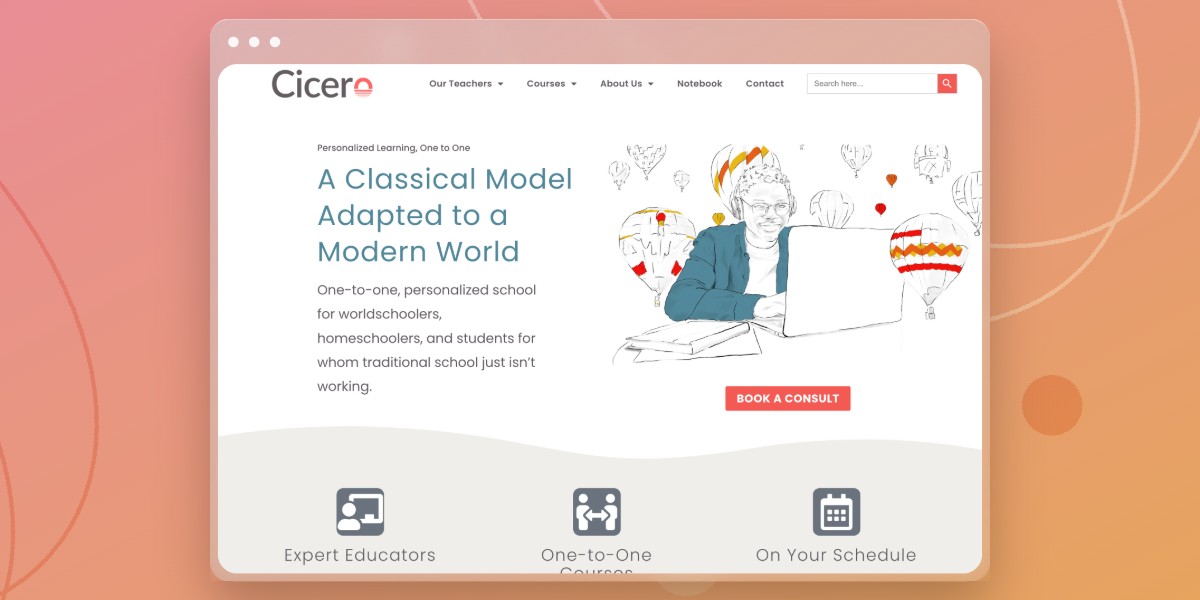
That belief sits at the center of Cicero, a personalized learning platform founded by former journalist and entrepreneur Paul Bennett. While many conversations in education focus on curriculum, technology, or test scores, Cicero starts with a different premise. The teacher-student relationship is the heart of learning.

A Personal Search for a Better Way to Learn

Bennett’s path to education began with his family’s experience. A longtime traveler, entrepreneur, and former journalist whose work appeared in publications including National Geographic and Wired, he spent a decade sailing around the world with his family.

The adventure raised an important question. How could children receive a meaningful education while living a life untethered from a traditional classroom?

The challenge was particularly relevant for families interested in homeschooling and alternative learning models. Many wanted flexibility without sacrificing educational quality or personal guidance.

That experience eventually led Bennett to create Cicero, a public benefit corporation that connects middle- and high-school learners with private teachers for one-to-one remote learning.

Why One Teacher Can Make Such a Difference

The idea behind Cicero reflects a long-standing educational principle. Students often learn best when a teacher has the time and space to understand them as individuals.

Research on one-to-one learning, including the well-known Bloom’s 2 Sigma findings, suggests that individualized instruction can produce substantially stronger academic outcomes than conventional classroom settings. When teachers can adapt lessons to a learner’s strengths, interests, challenges, and pace, learning becomes far more personal.

For Cicero, that personalization begins with the teacher.

Rather than positioning educators as generic tutors focused on completing assignments, the platform emphasizes expert teachers who act as mentors and guides. The goal is not simply to help a learner finish a course. It is to build an educational relationship grounded in trust, curiosity, and meaningful engagement.

That distinction matters because students rarely fit an average profile. A teenager fascinated by marine biology may need a different approach than one captivated by literature, entrepreneurship, or world history. One-to-one learning allows teachers to design courses around the learner rather than asking the learner to adapt to a standardized model.

Learning Built Around Real Lives

The model has found particular appeal among families pursuing homeschooling and worldschooling lifestyles.

For parents who travel frequently, work remotely, or seek alternatives to traditional schools, flexibility is often only part of the equation.

Many are also seeking deeper educational experiences that foster intellectual curiosity and independent thinking.

Cicero’s approach reflects those priorities. Lessons take place remotely, allowing learners to connect with teachers regardless of geography, while maintaining the consistency of an ongoing mentor relationship.

For families, that relationship can provide something increasingly difficult to find in large educational settings. A teacher who truly knows the learner.

The Lasting Value of Mentorship

Educational technology continues to expand, offering new ways to access information from virtually anywhere. Yet Bennett believes the most important element of learning remains deeply human.

A great teacher can challenge assumptions, build confidence, encourage questions, and help a learner recognize abilities they may not yet see in themselves.

Those moments often become the experiences students remember most.

As Cicero grows, Bennett’s vision remains focused on making that kind of mentorship accessible to more families. The platform’s mission is rooted in a simple but enduring idea. While lessons matter, relationships are often what make learning stick for a lifetime.