The rapid growth of artificial intelligence has created a familiar problem. Information is becoming easier to generate, but not necessarily easier to manage.
Organizations today have access to more documents, reports, databases, communications, and digital resources than at any previous point. Yet the challenge often lies in locating relevant information when it is needed. Employees spend considerable time searching for answers, reviewing records, and moving between disconnected systems. As information volumes continue to expand, knowledge management has become an increasingly important topic within enterprise technology discussions.
The issue is not limited to large corporations. Educational institutions, government agencies, research organizations, and small businesses face similar questions. How should knowledge be organized? How can information be accessed efficiently? And what role can artificial intelligence play in helping people find, understand, and use information more effectively?
Research continues to highlight the scale of the challenge. A study published by IDC estimated that the global datasphere would reach 175 zettabytes by 2025, reflecting the continuing growth of digital information across sectors. At the same time, organizations have increasingly invested in systems designed to improve information retrieval, document management, and knowledge sharing. The objective is often straightforward: making existing information more useful rather than simply creating more of it.
This broader environment has contributed to growing interest in enterprise knowledge platforms, AI-assisted search systems, and Retrieval-Augmented Generation technologies.
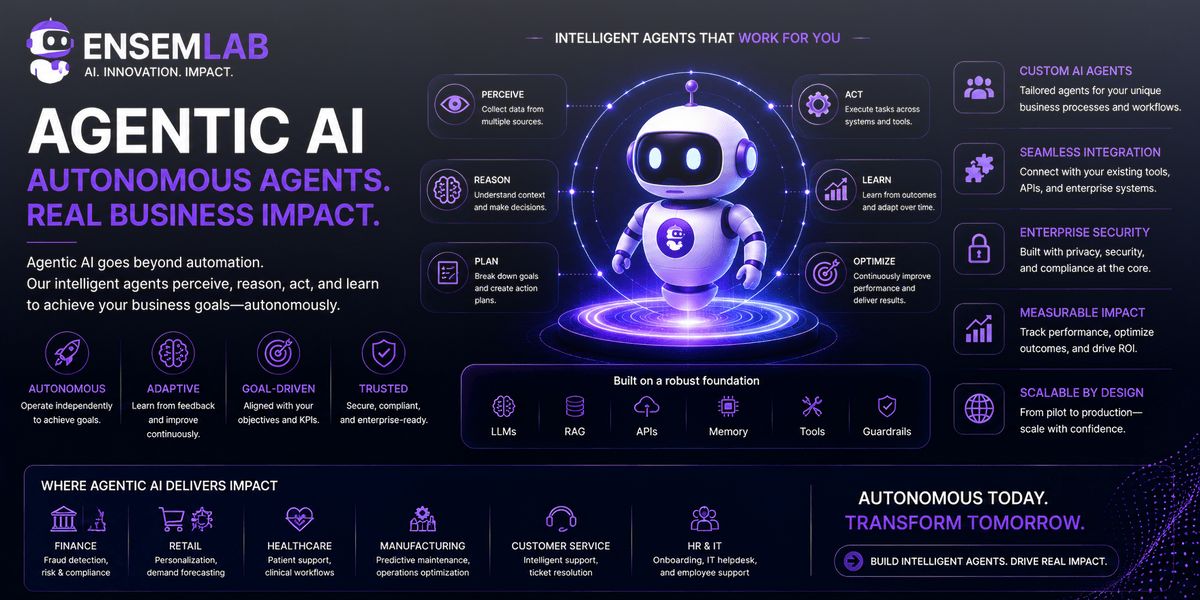
Established in Pakistan in 2024 by a group of entrepreneurs, Ensemblab operates within several areas of enterprise technology, including artificial intelligence, automation, digital twins, and regulatory technology. Alongside those activities, the company also maintains a focus on knowledge management, educational content, and AI-supported research systems. These initiatives occupy a different space from enterprise automation projects. Yet, they address many of the same concerns surrounding information access and organizational learning.
One aspect of this work involves the company’s online knowledge base.
Ensemblab provides information on various topics related to artificial intelligence, digital companions, enterprise technology, business innovation, and others. Technology firms often use knowledge bases to convey information on newly invented technology, developments in industries, and other relevant issues. These databases may have educational as well as informative value, especially in industries where technology develops rapidly and terminology keeps changing.
The growing demand for accessible technical information is not difficult to understand.
The technology of artificial intelligence has made its way into the discourse of businesses like never before. According to a 2024 study done by McKinsey, 72 percent of organizations said that they were using AI in at least one aspect of their business, as opposed to 55 percent who were doing so last year. Although more organizations are incorporating AI into their business, there is still much knowledge that is lacking when it comes to its practical application.
Knowledge management, however, involves more than publishing articles.
Organizations often struggle with internal information as much as external information. Documents may be spread across multiple systems. Policies may exist in separate repositories. Research materials, operational records, and procedural guidance are frequently stored in different locations. Finding information can become a time-consuming task, particularly in large organizations.
This challenge has helped drive interest in Retrieval-Augmented Generation, commonly referred to as RAG.
The technology combines information retrieval techniques with large language models. Rather than relying solely on model-generated responses, RAG systems retrieve information from designated sources before generating outputs. Researchers and enterprise technology providers have increasingly viewed the approach as a way of improving relevance and connecting AI systems with organizational knowledge repositories.
Ensemblab develops Retrieval-Augmented Generation systems intended to support enterprise knowledge management and research activities. According to company information, these systems are designed to combine information retrieval capabilities with generative AI technologies. Within organizational settings, such approaches can be used to assist information access, document retrieval, research support, and knowledge discovery.
The relationship between artificial intelligence and research has become a significant area of discussion across industries.
A report published by Deloitte in 2025 observed that many organizations were exploring AI-enabled research tools to assist employees with information gathering, document analysis, and knowledge retrieval. Yet the report also noted that successful implementation often depends on the quality and accessibility of underlying information sources. AI systems may accelerate access to knowledge, but they still rely on the availability of accurate and well-organized data.
This point is particularly relevant in enterprise environments.
Many businesses possess substantial institutional knowledge that exists across reports, procedures, archives, and operational records. In some cases, employees spend years building expertise that can be difficult to transfer or document. Knowledge management systems attempt to address that issue by improving access to organizational information and making knowledge more discoverable.
Beyond research support, Ensemblab’s activities in this area extend to digital onboarding solutions.
Onboarding programs are usually the early targets when implementing processes of automation in business. This is because onboarding is normally done through information gathering, verification, reviewing of documents, and workflow management. Digital onboarding systems are usually meant to ease all these activities by creating well-structured workflows and automated processes.
The implementation of automation in onboarding programs has become increasingly common over the last couple of years. According to reports published by Gartner, there is increasing interest among organizations in automating processes that help eliminate repetitive duties in the course of onboarding.
Taken together, these initiatives illustrate a recurring theme within enterprise technology.
Often, artificial intelligence gets into the limelight owing to the capability that such technology has for producing content or analyzing information. However, many companies and institutions hold other priorities, one of which is enhancing the availability of information. Such priorities can be associated with education, knowledge management systems, research tools, and even onboarding processes.
Ensemblab’s work in knowledge management and educational technology reflects that broader trend. Through its online knowledge base, Retrieval-Augmented Generation systems, enterprise research support technologies, and digital onboarding solutions, the company operates within a growing segment of the technology sector focused on information access and organizational learning. As businesses continue to manage expanding volumes of digital information, the ability to organize, retrieve, and apply knowledge is likely to remain an important part of the conversation surrounding artificial intelligence and enterprise technology.