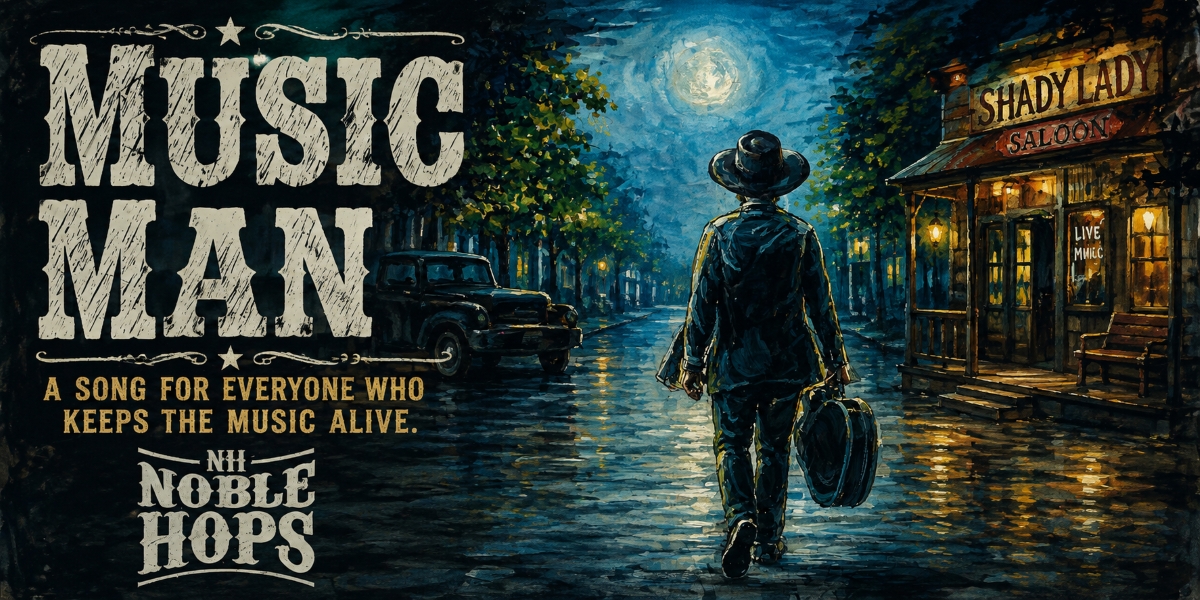

By: Caleb Whitmore
There is an old temptation when writing about musicians to confuse persistence with success. The business encourages it. Stay around long enough, we’re told, and somebody will notice. Play enough rooms, shake enough hands, drive enough miles, and eventually the road delivers you somewhere better.
Noble Hops’ “Music Man” understands that the road makes no such promise.
That may be the most compelling thing about this Western Pennsylvania band’s single. “Music Man” is ostensibly about a fictional traveling musician, but there is little about him that feels invented. He belongs to that enormous, largely undocumented fraternity of players who spend their lives carrying guitars through side doors, playing for tips and beer, driving home after midnight and returning the following weekend because they cannot imagine doing otherwise.
Utah Burgess announces the terms immediately: “I didn’t sell my soul for rock and roll, but it became my way of life.”
There’s a lot contained in that distinction.
The old crossroads story depends upon a transaction: surrender something precious and receive greatness in return. Burgess’ character gets no such bargain. He simply chooses music and accepts whatever follows. Empty bars. Beat-up guitars. Ex-wives. Small money. Long roads.
And still, remarkably, no regret.
That places “Music Man” squarely inside the best tradition of American roots songwriting, where dignity often resides not in winning but in continuing. Noble Hops calls its sound American rock and roll with Americana and alt-country grit, which is accurate enough, though categories seem less important here than attitude. This is music made by people who understand work.
Burgess certainly does. His background includes years spent working steel-mill shifts alongside the sort of people who rarely become protagonists in fashionable pop songs. That experience has consistently informed Noble Hops’ writing. His characters tend to carry responsibilities, scars, and convictions. They work. They lose things. They keep moving.
The Music Man could comfortably stand among them.
Burgess handles vocals, 12-string acoustic and electric rhythm guitar, while Tony Villella contributes electric rhythm and lead guitar. Johnny “Sleeves” Costa supplies bass and backing vocals, and Brad Hulburt drives the band from behind the kit.
The performances aren’t constructed around virtuosity. That’s a compliment. Villella knows when a guitar should speak and when it should stay out of the singer’s way. Costa and Hulburt provide the dependable foundation required by a song whose primary concern is narrative. Together, Noble Hops sounds like a working band rather than a collection of musicians waiting for individual solo opportunities.
That difference matters.
“Music Man” was recorded with Jazz Byers at Pittsburgh’s Rattle Clack Studio, although getting there took time. The band initially began recording the song in January 2024, discarded those tracks, and eventually started again.
Burgess has explained the decision simply: the song wasn’t ready.
For a recording about perseverance, there is an appealing symmetry in that history. Sometimes craft means knowing when to keep pushing. Sometimes it means admitting the thing in front of you isn’t right and beginning again.
The finished recording possesses the lived-in quality the lyric requires. Nobody has polished the fingerprints from it.
Its chorus is almost defiantly plain: “Music Man, playing across the land / Music Man, that’s what I am.”
A songwriter could certainly devise something more complicated. Burgess instead gives his character a statement of identity. The repetition matters because this man has ceased distinguishing between what he does and who he is.
That may be familiar territory to anyone who has pursued music beyond the point of reasonable financial explanation.
Noble Hops knows something about mileage itself. The band has played 89 shows at 52 venues over a little more than a year, covering territory from Franklin, Tennessee to Erie, Pennsylvania and from Altoona, Pennsylvania west to Mansfield, Ohio. They have also accumulated multiple Josie Music Awards nominations.
But “Music Man” is interesting precisely because those achievements don’t become its definition of success.
Instead, Burgess eventually turns toward the only measurement nobody outruns: time.
“The time will come when I’ll be gone,” he sings, imagining his songs surviving in empty bars and on battered guitars.
That is a smaller ambition than immortality and perhaps a more beautiful one.
Burgess has spent years preserving other musicians’ work through The Grass Roots Show on Butler, Pennsylvania’s Rock Station 97.7. He knows songs can remain after their creators disappear because he has participated in keeping them alive. Consequently, when “Music Man” considers legacy, it doesn’t sound like rock-star vanity. It sounds like somebody hoping the work mattered to another person.
Americana has always been particularly good at honoring people history overlooks: laborers, wanderers, farmers, bartenders, broken families, and musicians whose names never reached marquees.
“Music Man” belongs to that tradition.
Noble Hops isn’t asking us to believe its protagonist secretly deserved superstardom. That would cheapen him. His victory is simpler.
He played.
He paid his dues.
He remained himself.
And when morning arrived, he put the guitar back in its case and headed toward the next room.
There are worse definitions of a life well lived.