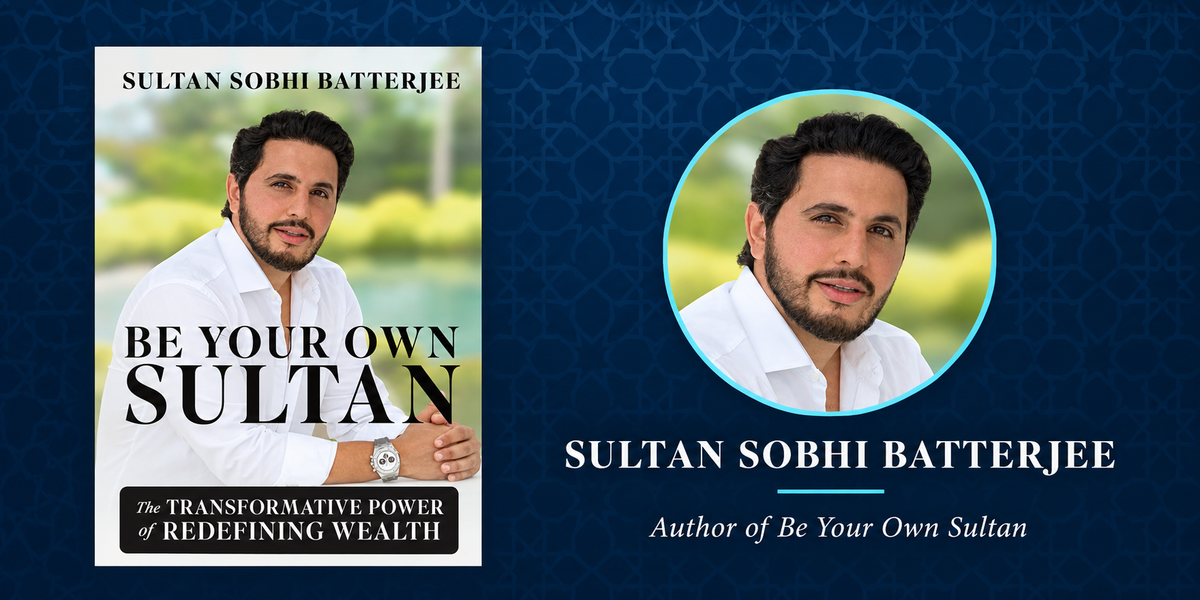

Sultan Sobhi Batterjee did not choose the name at the center of his book.
His parents gave it to him.
In Arabic tradition, the word Sultan carries centuries of meaning. It suggests authority, power, strength, and sovereignty. It became associated with leaders whose influence extended over territory and people.
That history gave Sultan the starting point for Be Your Own Sultan: The Transformative Power of Redefining Wealth, but he does something unexpected with it.
He takes the idea of dominion and turns it inward.
Instead of asking how much control a person has over a business, an organization, or the world around them, Sultan asks whether they have authority over their own mind, time, priorities, and definition of a well-lived life.
For someone who has spent decades leading businesses and institutions, that change in direction is not theoretical.
It grew from realizing that external authority can coexist with surprisingly little control over your own life.
The Hardest Territory to Govern
Sultan had already accumulated many of the things normally associated with power and success. He became Chairman and CEO of IHCC, founded Lifestyle Developers and Greener, chaired Sultan Batterjee Holding, and served across institutions in healthcare, education, construction, and other industries.
Yet one of the most important moments in his personal journey came when he was sitting alone in his office after everyone else had gone home.
His phone was quiet. Friends had stopped calling after years of declined invitations. His wife and children were already asleep.
He had authority over businesses, but his time had gradually stopped feeling like his own.
That contradiction became difficult to ignore.
The title Be Your Own Sultan emerged from the belief that self-leadership deserves at least as much attention as the leadership of companies.
A Different Meaning in Different Cultures
Sultan is conscious that the title carries different weight depending on who reads it.
For readers in the Arab world, the idea of sovereignty, honor, and leadership has familiar cultural roots. Turning those concepts inward can feel surprisingly provocative because it asks someone to apply the same seriousness to their internal life that society often applies to external achievement.
For Western readers, Sultan expects the term may feel more historical or unfamiliar.
But the underlying idea is universal.
There are many things people cannot control. Markets move. Careers change. Organizations evolve. Other people make their own choices.
The one territory that can never be fully delegated is the way someone chooses to define and organize their own life.
The City Built Before You Arrive
That idea becomes more complicated when family expectations enter the picture.
The Batterjee family has one of the longest business histories in Saudi Arabia. Sultan grew up inside a legacy shaped by healthcare, real estate, education, business, and philanthropy.
He describes the inherited expectations surrounding that kind of family as a City of Expectations.
It is built by people who love you. That is exactly what makes it difficult to leave.
The expectations may come from good intentions, but they still create a blueprint for what success should look like. Sultan eventually had to ask how much of his ambition came from his own desires and how much came from the role he believed he was supposed to play.
He does not present authenticity and family loyalty as enemies.
His realization was that honoring where you come from does not require surrendering the right to decide where you are going.
The Dinner Table With Deepak Chopra
One of the stories Sultan tells captures the idea of internal sovereignty in a much smaller moment.
At an event in Riyadh, Deepak Chopra was the keynote speaker. Later, during dinner, Chopra was sitting alone because the other guests seemed too intimidated to join him.
Sultan walked over, introduced himself, and asked if he could sit down.
They spent the evening talking about medicine, self-improvement, and life.
Years later, Chopra would read Sultan’s work and praise its exploration of true abundance. For Sultan, however, the original dinner mattered because it had nothing to do with status.
It was a question of self-worth. He did not need permission from the room to take the seat.
Power Without Inner Authority Is Incomplete
This is the larger argument behind Sultan’s redefinition of the word.
Being your own Sultan is not about withdrawing from ambition or rejecting external success. Sultan is still deeply involved in business, leadership, investment, development, and institution building.
The difference is that none of those things are allowed to define the entire meaning of wealth.
Authority over other people may be impressive. Authority over your own priorities may be harder.
And for Sultan, it is the form of sovereignty that ultimately determines whether success belongs to you or whether you belong to it.
For readers interested in redefining power, wealth, and self-leadership, Be Your Own Sultan by Sultan Sobhi Batterjee is available now on Amazon.