
By: Kristine Kennedy
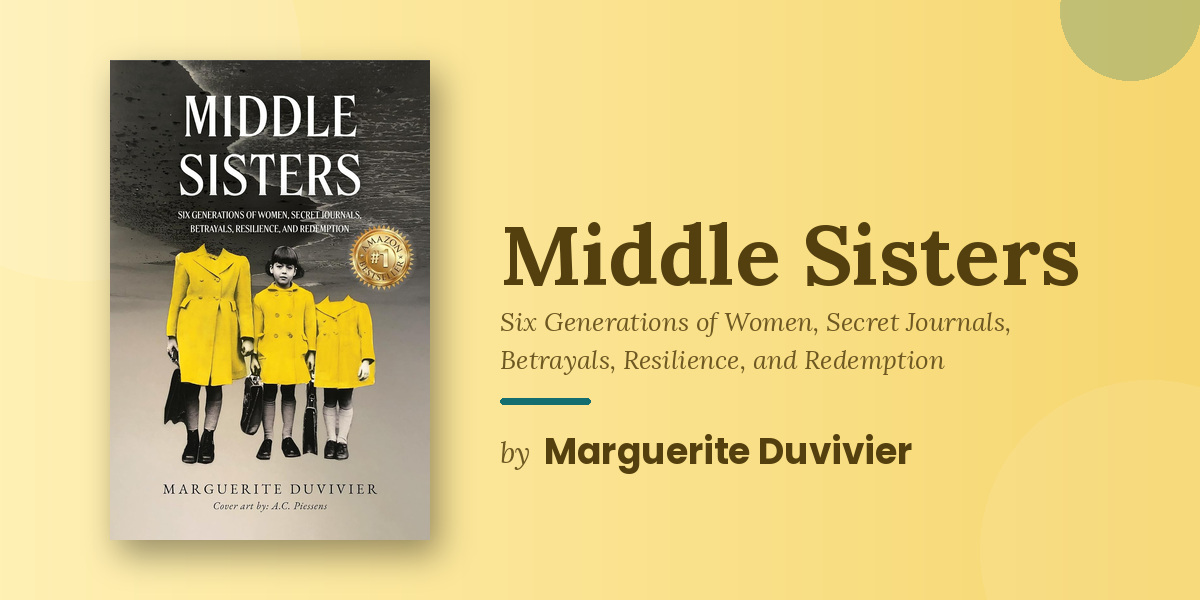
The women whose stories fill Middle Sisters were not the kind of women who made official history. They were the kind whose lives happened in the spaces between official history, shaped by the wars and the economics and the social structures that surrounded them without ever fully controlling them, and who left their own record not in archives or newspapers but in secret journals discovered posthumously, in the memories of children who were watching even when they were not supposed to understand what they saw, and in the patterns of behavior that repeated and occasionally broke across six generations. Marguerite Duvivier, writing under a pseudonym, is the Associate Professor in Anatomic Pathology who examined all of this evidence and wrote the memoir that finally gives these women the honest account they were never going to receive from any other source.
The saga begins in Belgium in 1908 with Lydie, the dominant mother whose decision to coerce her middle daughter Zilda into a loveless marriage with a greedy and self-serving man sets in motion a pattern that the memoir traces with unflinching specificity across the generations that follow. The coercion is not abstract. It is a specific act in specific circumstances by a specific woman whose own relationship to power and to her daughters is rendered with the complexity that makes her comprehensible even when she is not forgivable.
Zilda, the middle daughter who becomes the memoir’s first sustained focus, spent her life in the loveless marriage her mother arranged and kept her private record of it in journals that she never intended anyone to read. The posthumous discovery of those journals is the archival event that makes the memoir possible in its most intimate and most specific form, providing documentary evidence of an interior life that the official version of Zilda’s existence never acknowledged. Her own middle daughter Marguerite, fiercely independent and determined to chart a different course, married a brilliant and unfaithful man whose gifts and flaws exist in genuine proportion and whose relationship with Marguerite is rendered without the simplification that would make him easier to dismiss.
Despite favoring Marguerite’s sisters during their formative years, it is Marguerite that Zilda leans on during her later years, a reversal that the memoir treats with the complexity it deserves. The pattern of the middle daughter, overlooked in formation and relied upon in decline, is the book’s most quietly devastating and most universally recognizable insight, connecting the specific experiences of Lydie’s daughter and Zilda’s daughter to a pattern that millions of readers will recognize from their own family histories.
If you have ever been the middle daughter, or loved one, or suspected that the women in your family carried more private history than they ever disclosed, Middle Sisters by Marguerite Duvivier is the memoir that sees all of it and has the courage to write it down. Pick up your copy on Amazon today and discover what Zilda’s secret journals finally allow the world to know.