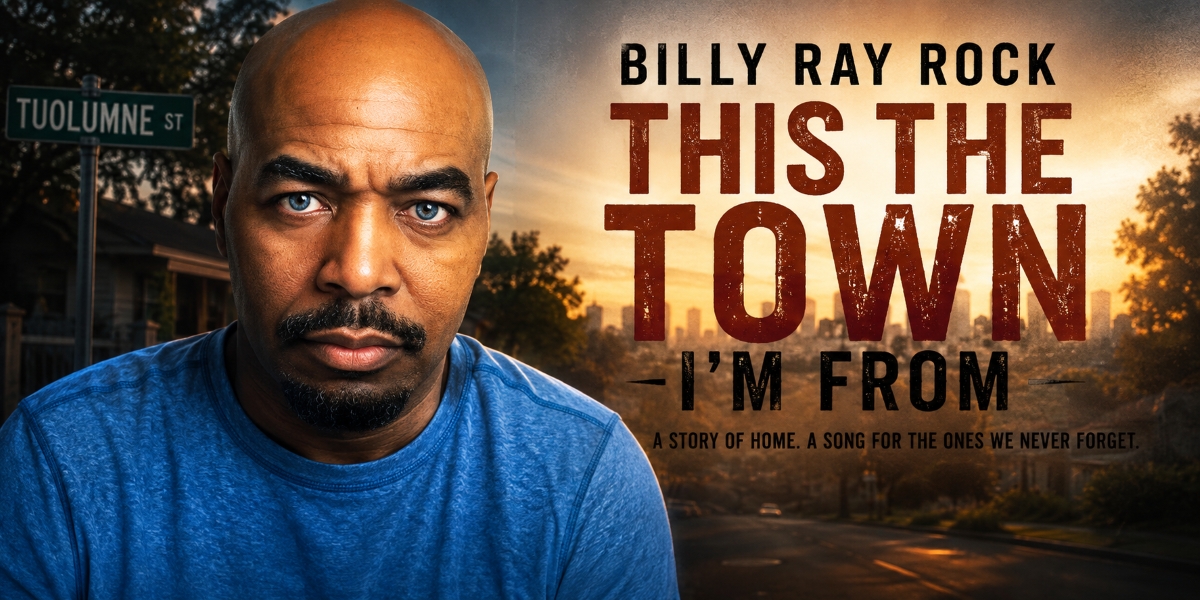

Hometown songs are dangerous business. Write one badly, and you get tourism-board country: street signs, Friday nights, mama’s cooking, obligatory hardship, everybody raise a glass. Billy Ray Rock includes several of those ingredients on “This the Town I’m From” and somehow avoids most of the traps. The reason is simple enough. He isn’t selling Fresno. He’s mourning time.
Rock grew up on Tuolumne Street in Fresno, California, in a crowded house where money was scarce, and entertainment frequently meant whatever the kids could invent. He remembers walking barefoot to the store, playing with a water hose, county fairs, backyard moonshine, oxtails and greens, old folks dancing and young folks making noise. None of this sounds extraordinary until you understand that extraordinariness is precisely what Rock rejects.
He knows ordinary life becomes precious after it disappears.
“This the town I’m from / It’s small but made me strong,” goes the chorus, grammar left conversational because polishing it would defeat the point. This isn’t Billy Ray Rock presenting himself as the poet laureate of Fresno. It’s a grown man remembering how people actually talked, lived, ate, and survived.
And survival matters here.
The poverty of Rock’s childhood isn’t repackaged as heroic suffering. He has spoken about how growing up with little made commonplace comforts later feel almost like wealth. That’s a more complicated observation than the standard entertainment-industry narrative in which poverty exists mainly as Act One before fame arrives in Act Three. Rock understands deprivation as something that alters your measurements permanently.
Musically, his genre promiscuity suits him. Soul, R&B, hip-hop, blues and country storytelling coexist because Rock apparently sees little reason they shouldn’t. Growing up listening to radio that might move from Hall & Oates to the Ohio Players, Elton John to Earth, Wind & Fire taught him the useful lesson that genre classifications are principally somebody else’s administrative problem.
If it feels good, use it.
That attitude gives “This the Town I’m From” an appealing lack of anxiety. It doesn’t spend four minutes desperately informing you what demographic should enjoy it. The song simply settles into its story and lets Rock’s voice do what matters most: communicate.
Which brings us to death.
Rock originally populated this song’s emotional rearview mirror with parents, siblings, and other people who had vanished from his life. Then his wife died. She had been profoundly affected by the song and its accompanying video; Rock has said she could barely watch the video because of the emotions it stirred. Now the record contains another ghost.
That changes everything without changing a note.
Suddenly “My folks have come and gone” isn’t merely nostalgic bookkeeping. It’s the organizing principle. People disappear. Houses remain. Somebody else moves in. Their kids run around the rooms where yours once did. Eventually they leave too. The building doesn’t care.
Rock does.
His smartest lyrical turn comes when recollection gives way to instruction. “Life is short, kids grow up fast,” he observes, before urging listeners to hold their people close. Hardly a revelation, except that pop music has spent seventy years demonstrating that familiar truths become clichés only when the singer doesn’t believe them.
Rock believes this one.
Fatherhood has apparently accelerated his move away from the artist’s most boring obsession: himself. He has said that raising his two youngest children means more to him than his musical accomplishments and that losing his wife altered his relationship with artistic recognition. Once, making a great record meant enjoying some of the “shine” that came with being its creator. Now he’s more interested in whether the song gives somebody else a few meaningful minutes.
That’s maturity, which rock criticism traditionally treats with suspicion because maturity frequently means acoustic guitars, tasteful production, and nobody having any fun. But Rock’s version is different. His maturity means understanding that legacy isn’t how brightly the spotlight hits you. It’s what survives after somebody switches it off.
“This the Town I’m From” occasionally risks sentimentality because sentiment is its subject. It repeats its central idea because choruses do that. And its hometown imagery could sound familiar, detached from the life behind it.
But detach it, and you’ve missed the record.
The song works because Tuolumne Street isn’t symbolic to Billy Ray Rock. It’s Tuolumne Street. The barefoot kid was him. The crowded house was his. The dead are his dead. Fresno isn’t shorthand for blue-collar authenticity. It’s where the memories happened.
And that specificity is what permits everybody else inside.
You don’t need to have grown up poor in Fresno. Substitute your street. Your kitchen. Your siblings. Your stupid childhood game. Your mother’s food. Your person who isn’t there anymore.
Then Rock’s hometown song becomes yours.
“This the Town I’m From.” Turns out nostalgia improves considerably when somebody remembers what it costs.