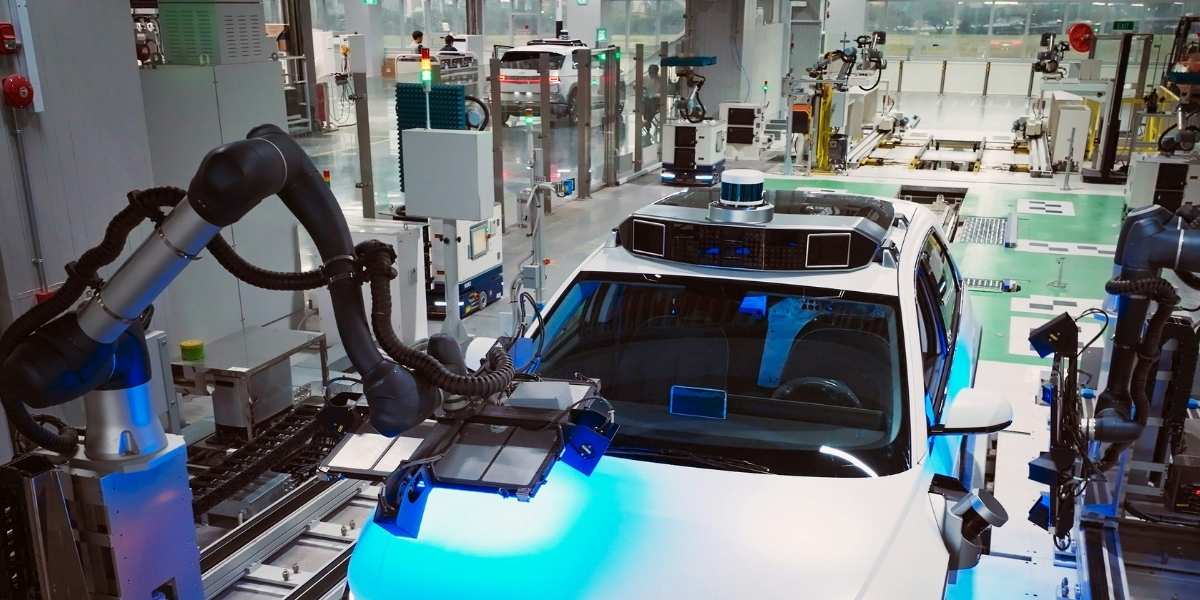

XPeng plans to roll out flying cars and robotaxi deliveries next year, as the company said it aims to begin delivering its aerial vehicles and autonomous ride-hailing services while scaling up production capacity for its emerging mobility technologies.
The announcement was confirmed by Brian Hongdi Gu, who outlined the company’s near-term rollout plans alongside longer-term manufacturing goals. The timeline places initial deliveries ahead of a broader production scale-up targeted for 2027, positioning the company to enter both advanced air mobility and autonomous transport markets within a defined commercial window.
Commercial rollout timeline and early deployment plans
XPeng’s roadmap indicates that initial deployment of flying vehicles and robotaxis could begin in 2026, supported by ongoing testing and development efforts. The company has signaled that 2027 will serve as a critical milestone year for scaling operations, including broader testing programs conducted in collaboration with partners across multiple regions.
The early delivery phase is expected to focus on controlled environments and pilot programs, particularly for robotaxi services. XPeng has identified Guangzhou as one of the first cities for autonomous vehicle testing, reflecting a localized rollout strategy aligned with regulatory and infrastructure readiness.
The company’s approach to phased deployment mirrors existing practices in autonomous mobility, where limited launches are used to validate performance and safety systems before expanding to larger markets. By setting a defined delivery window, XPeng is establishing a clear timeline for transitioning from development to commercial application.
Scaling production capacity for flying vehicles
XPeng has already begun preparing its manufacturing infrastructure to support the anticipated increase in demand for flying vehicles. The company’s production facility entered trial operations in November 2025 and has since produced its first aircraft unit, marking an early step toward industrial-scale manufacturing.
The facility is designed with an initial annual capacity of 5,000 units, with plans to expand to 10,000 units as production stabilizes. At full output, the assembly line is expected to produce one aircraft approximately every 30 minutes, indicating a focus on high-throughput manufacturing processes.
The company’s flagship flying vehicle, known as the Land Aircraft Carrier, integrates both ground and aerial mobility components. It has reportedly secured more than 7,000 pre-orders globally, providing an early indication of market demand ahead of mass production. These orders may support initial revenue generation once deliveries commence.
XPeng has also emphasized ease of operation as a key feature of its flying vehicle design. The system includes an intelligent cockpit and simplified control interface intended to make the aircraft accessible to users without extensive aviation training.
Development of hybrid aircraft for extended applications
In addition to its fully electric model, XPeng is developing a hybrid flying vehicle identified as the A868. This aircraft is designed to support longer-range travel and commercial use cases, expanding the potential applications of the company’s aerial mobility platform.
The A868 incorporates a tilt-rotor configuration and a hybrid-electric propulsion system, which is expected to enable a range of approximately 500 kilometers. The vehicle may reach maximum cruising speeds of up to 360 kilometers per hour, positioning it for intercity travel scenarios.
The six-seat cabin is configured to accommodate business and group travel, indicating a potential focus on corporate mobility services. By offering both electric and hybrid variants, XPeng is addressing different operational requirements, including range, payload, and energy efficiency.
Both aircraft models are being developed through XPeng’s subsidiary focused on low-altitude mobility, reflecting a vertically integrated structure that allows the company to manage design, production, and system development within its own ecosystem.
Robotaxi development and autonomous driving capabilities
XPeng’s expansion into robotaxis represents a parallel track in its broader mobility strategy. The company has stated that it will begin testing its autonomous ride-hailing services in 2026, with further trials planned internationally in 2027.
The robotaxi platform is built on XPeng’s in-house autonomous driving technology, which includes a full-stack system developed internally. The vehicles are equipped with multiple high-performance computing chips, delivering processing power sufficient to handle real-time navigation and decision-making tasks.
The integration of autonomous driving systems with commercial ride-hailing services is intended to create a scalable business model for urban mobility. XPeng’s timeline suggests that the company aims to align robotaxi deployment with advancements in both software capability and regulatory approval.
Testing programs are expected to play a critical role in refining system performance and ensuring compliance with safety standards. The phased rollout approach allows XPeng to collect operational data while gradually expanding service availability.
Partnerships and broader technology portfolio expansion
XPeng’s growth strategy includes collaboration with established automotive manufacturers, notably Volkswagen. The partnership has already produced a jointly developed electric vehicle, the ID.UNYX 08, which was introduced as part of a localized strategy targeting the Chinese market.
The collaboration reflects a broader effort to combine XPeng’s technology capabilities with Volkswagen’s manufacturing scale and market presence. Additional cooperation between the companies may be explored as XPeng expands its product portfolio and enters new mobility segments.
Beyond vehicles, XPeng is also investing in humanoid robotics, with plans to begin large-scale production in the fourth quarter of 2026. These systems are designed with features such as bionic structures and flexible materials, indicating a focus on advanced automation technologies.
The company’s diversified approach spans electric vehicles, flying aircraft, autonomous transport, and robotics, forming a multi-segment technology portfolio. This structure allows XPeng to pursue multiple revenue streams while leveraging shared research and development capabilities across its platforms.
The expansion into different mobility and automation sectors is supported by increasing international activity. XPeng has reported that overseas markets contributed a portion of its total sales and revenue in 2025, signaling ongoing efforts to extend its global reach as it prepares for the next phase of commercial deployment.