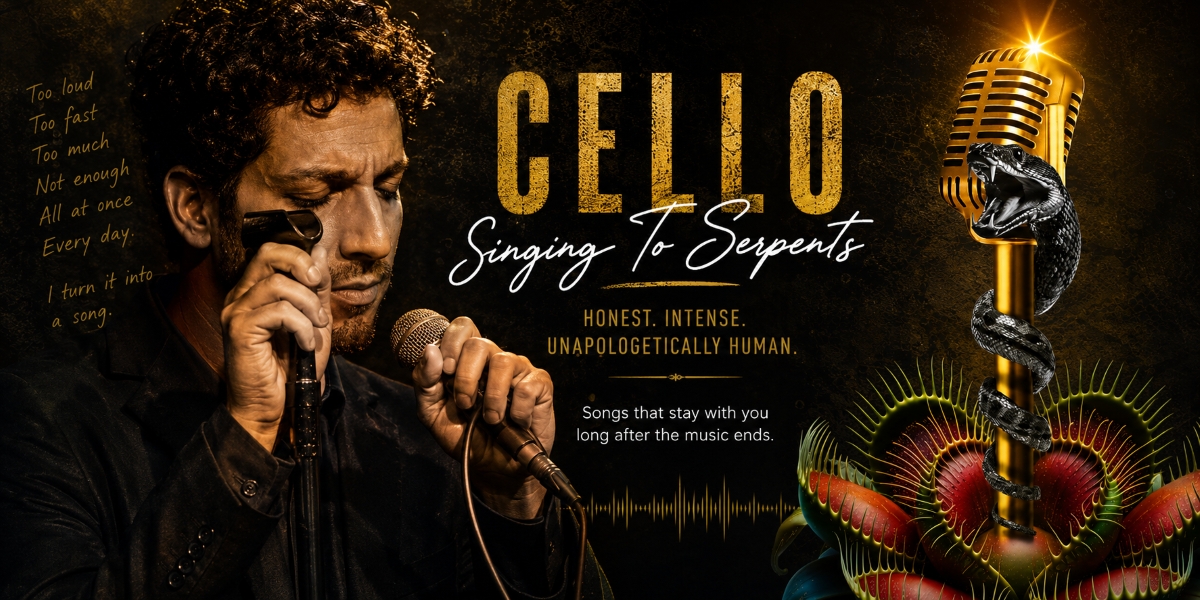

By: Marcus Ellington
The music business has always had a peculiar relationship with outsiders. It worships them after they become successful and tries desperately to straighten them out beforehand. Every generation produces artists who are told they are too strange, too intense, too complicated, too difficult to categorize, and then, if fortune smiles, those very qualities become the mythology upon which careers are built.
Enter Cello, an artist for whom being different isn’t a costume purchased at some fashionable boutique of rebellion. It is simply the condition of existence.
Cello is autistic and has ADHD, facts that could easily become promotional shorthand in an era when identity is routinely compressed into hashtags. But reducing Cello to his neurodivergence would miss the point spectacularly. Autism and ADHD aren’t gimmicks attached to the music. They are elements of the perceptual machinery producing it.
And that distinction is important.
Cello’s career has increasingly been built around turning internal experience into public communication. His music inhabits those uncomfortable territories where anxiety rubs against hope, isolation encounters connection, and identity becomes something constantly examined rather than permanently settled.
His album Singing to Serpents may be the clearest expression of that artistic personality.
Even the title sounds like something from mythology: the musician standing before creatures traditionally associated with danger, temptation, knowledge, and transformation, attempting not to kill them but to communicate with them.
That’s practically a definition of songwriting.
Cello doesn’t run from emotional serpents. He sings to them.
The record moves through questions of belonging, self-acceptance, fear, faith and resilience without pretending that three minutes and a catchy chorus can solve them. There is something refreshingly unfashionable about that approach. Much contemporary pop arrives determined to tell listeners exactly how they should feel. Cello seems more interested in documenting what feeling actually resembles when nobody is watching.
His neurodivergence inevitably becomes part of this equation.
Autism and ADHD can influence attention, sensory experience, communication and the way an individual processes the surrounding world. For an artist, those differences can become creative materials. Cello’s work frequently carries the sensation of someone examining emotional details under magnification, noticing contradictions and textures that another songwriter might discard on the way to the chorus.
Then there is intensity.
Popular music desperately needs intensity, although the industry frequently attempts to manufacture it. Producers add another guitar, another vocal track, another beat, another digital explosion.
Cello’s intensity originates somewhere else.
It comes from investment.
You sense that these songs matter to the person singing them. The difference is enormous. Technology can make practically anyone sound dramatic. It cannot make someone sound invested.
That sincerity has helped Cello develop an artistic identity in which vulnerability isn’t presented as weakness or heroic triumph. It simply exists. There are doubts. There are victories. There are moments when the world makes sense and others when it appears to have been assembled without consulting the instruction manual.
In other words, there is life.
That may explain why the neurodivergent aspect of Cello’s story has relevance beyond biography. There are young musicians, writers, and artists growing up believing that success requires sanding away whatever makes them unusual. Social media has only intensified the contradiction. Everyone is encouraged to “be authentic,” provided that authenticity fits neatly into a fifteen-second video.
Cello offers another possibility.
Don’t eliminate the difference.
Investigate it.
Turn it into something.
His career suggests that the peculiarities of perception, the obsessive focus, emotional intensity, unconventional associations, and restless movement of thought can become artistic resources when given structure. Music supplies that structure. Rhythm organizes chaos. Melody gives emotion somewhere to travel. Lyrics transform private thought into something another human being can recognize.
That is where Singing to Serpents becomes more than an album title.
The serpent can be anxiety. It can be self-doubt. It can be the expectations of other people. It can even be the music industry itself, forever whispering that an artist might become successful if only he became slightly more like somebody already successful.
Cello’s answer appears to be remarkably simple: keep singing.
There is no guarantee attached to that philosophy. Independent music rarely offers guarantees. Careers rise, disappear, return, and mutate. Algorithms change. Audiences move elsewhere. Yesterday’s indispensable platform becomes tomorrow’s digital ghost town.
What survives is identity.
Cello has one.
He is a neurodivergent artist making emotionally candid music in an industry frequently devoted to emotional simulation. His autism and ADHD are neither tragic obstacles nor magical superpowers. They are pieces of a complicated human being whose particular way of experiencing the world has helped shape his particular way of making music.
And perhaps that’s the most interesting thing about Cello.
He isn’t asking the world to overlook what makes him different.
He’s asking us to listen to what happened because of it.