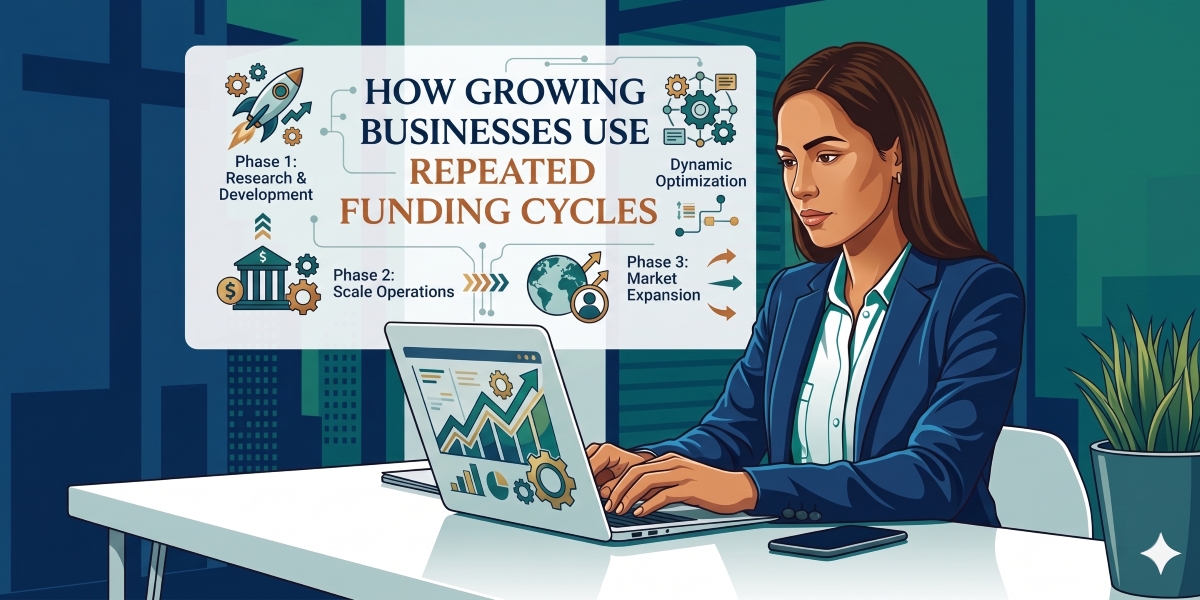

The business owners who get the most from business funding are not always the ones who access the largest single round of capital. They are often the ones who use funding cycles strategically across multiple rounds, building a track record that informs how a lender views each subsequent application. In 2026, the availability of small business loans through platforms that consider prior history has made repeated funding cycles a practical growth tool for many small businesses.
Understanding how to use repeated funding cycles strategically starts with understanding how modern business funding solutions evaluate businesses with a prior funding history, how each round informs the next, and what a business owner should focus on within each cycle.
How the Track Record Develops
AI-powered evaluation systems behind modern direct lending platforms are not designed to assess each application in isolation. They incorporate a business’s full history with the platform into each successive review. A business that has managed a prior funding round well, deploying the capital as indicated at application, maintaining the cash flow performance that supported the original evaluation, and meeting the agreed repayment terms, has built the kind of operating history that contributes to subsequent evaluations.
When a business has performed well in round one, the evaluation in round two has more data to draw on. The AI system has direct evidence of how the business manages capital under real operating conditions. The resulting offer can reflect that demonstrated history rather than depending on third-party indicators alone. This is a specific change in how the business is evaluated, not a theoretical benefit.
What to Focus on in Each Cycle
The foundation of a useful track record with a direct lender is straightforward. Deploy the capital in the way the business indicated it would at the time of application. Maintain the cash flow performance that supported the evaluation. Meet the agreed repayment terms. Business owners who do these three things consistently across multiple funding cycles develop a working relationship with their capital partner over time.
A business owner who has completed several funding cycles with a single platform is in a different position than one applying for the first time, and the evaluation considers that history. For business owners who want access to working capital that reflects their actual operating record rather than starting from a blank slate each time, the long-term relationship model has practical merits.
Aligning Each Cycle With a Growth Investment
The most useful repeated funding cycle approach aligns each round with a specific growth investment that moves the business from its current stage toward the next. AI-powered underwriting reads each business’s performance at the time of application and produces an offer that reflects the capacity the business has demonstrated to that point. Business owners who connect their funding requests to specific, well-supported investment plans tend to receive evaluations that take both the quality of their planning and the quality of their performance into account.
Business owners who apply for a business loan through Fundivi for a second or third round will find that the evaluation considers their performance in prior rounds. The AI system reads account data from the full relationship period and produces an offer that takes that history into account.
The Long-Term Capital Partner Approach
Fundivi’s lending platform for repeated funding cycles is designed to serve as a long-term capital partner for growing small businesses. As the business grows, the platform can grow with it, with capital access on terms that consider the developed track record. For small business capital strategy across multiple years and growth stages, choosing a lender that considers the borrower’s history can be a meaningful factor.
The market for business loans for small businesses now includes platforms that have built their evaluation infrastructure around this kind of compounding relationship. Fundivi is a direct lender that has structured its platform around a long-term capital relationship model, where the lender’s understanding of the business develops with each successful funding cycle.
Businesses that build strong capital positions through repeated funding cycles tend to approach each round with a clear thesis about how the capital will be deployed and what it is intended to support. An AI evaluation system that reads current performance data also reads the coherence of the business owner’s capital deployment history across prior rounds. A business that has used each prior round to fund a specific investment tied to measurable operating activity is developing the kind of track record that informs subsequent evaluations.
Business owners planning their second or third funding round with Fundivi should also be thinking about how the data from their current operating period reflects the impact of capital they have previously deployed. Equipment funded in an earlier round may show up in current operating activity. Team members hired with prior capital may be contributing to current operations. Marketing investment from prior rounds may be visible in current customer acquisition patterns. The AI evaluation reads all of this in context and forms a picture of the business that reflects both current performance and the history of how funded capital has been used.
This context is a meaningful factor in the evaluation of businesses that have completed multiple funding rounds with a single platform. An evaluation system that has observed a business deploy capital across multiple cycles has evidence of how the business owner uses capital, and that evidence informs the size and structure of subsequent offers. The compounding value of this context is one reason why building a long-term relationship with a single lending platform can be different from accessing capital opportunistically from multiple sources without establishing a track record anywhere.
Business owners who approach each funding round with the same strategic clarity they bring to other major decisions tend to know what the capital will fund before they apply, have a clear view of what the investment is intended to support, and choose a lending partner that evaluates their business with care and considers their track record across each round.
For a business owner building a multi-round capital relationship with Fundivi, the relationship is a connection to a capital source that understands the business, evaluates its performance with relevant context, and considers the borrower’s track record across each cycle. The work required to develop this relationship is the same work required to manage the business well, with consistent performance, clean banking, and thoughtful capital deployment. The businesses building strong capital positions in 2026 are doing it one well-managed funding cycle at a time through platforms that consider each cycle in the context of the next.