
By: Mikaela Junn
A Young Field With Unresolved Questions
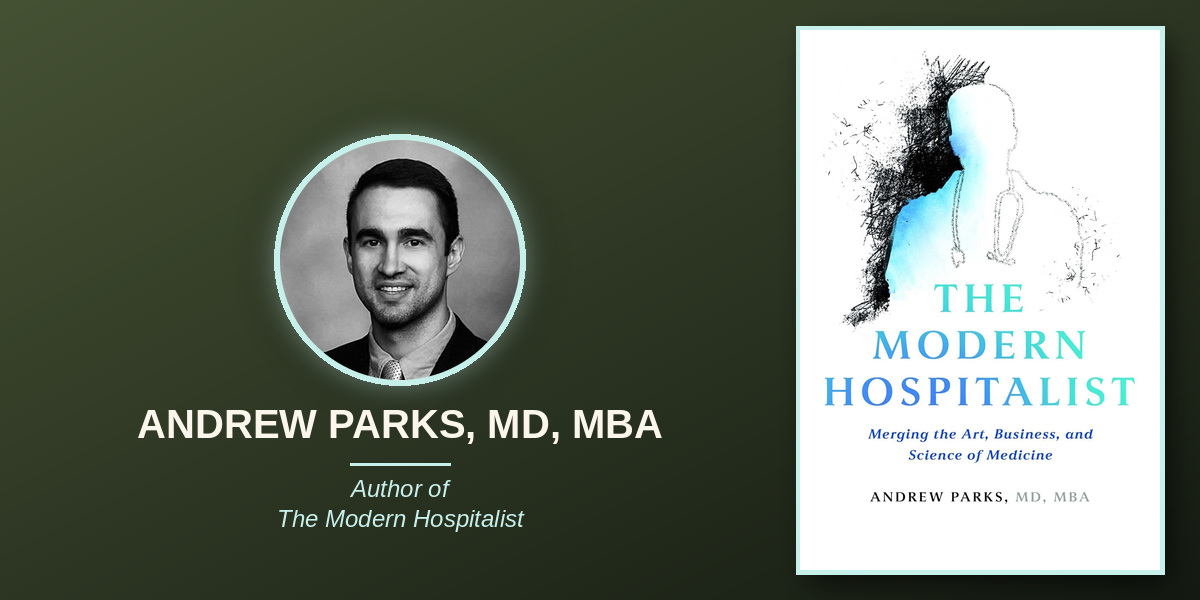
The word hospitalist dates to 1996. By any historical measure, that makes it one of the youngest recognized specialties in American medicine, and it is still forming its identity in ways that have real consequences for patients and physicians alike. When Andrew Parks started practicing in his hometown of Corbin, Kentucky, in 2019, patients would tell him he was not their regular doctor. Now they ask whether he sees patients in the office. That shift in trust is real, but Andrew does not treat it as evidence that the field has arrived. The Modern Hospitalist: Merging the Art, Business, and Science of Medicine takes the unresolved questions of hospitalist identity seriously because Andrew believes the answers will determine whether the specialty fulfills its commitment to patients and the physicians who chose it.
The Continuity Problem
The first unresolved question Andrew names is continuity. Hospitalists gained depth in acute care, but patients lost the physician who knew them. One patient told Andrew that he was probably not coordinated enough for fly fishing, because that patient’s primary care physician knew he loved it and Andrew did not. That observation, he writes, still stings. The handoff problem is real and consequential. Care transitions are among the highest-risk moments in a patient’s hospital stay, and hospitalists, who see the whole hospital every day, are positioned to get dramatically better at them. The field has not yet solved this, and patients bear the cost of that gap. Andrew argues that hospitalists need to invest seriously in handoff systems and care transition protocols, not because it is administratively convenient but because it is clinically essential.
The Sustainability Crisis
The second unresolved question is sustainability. Workloads, schedules, and burnout rates in hospital medicine tell a story that the field has not fully reckoned with. The current model is stretching people thin, and Andrew does not soften that assessment. He writes about the daily experience of carrying twenty-plus patients while an EMR full of alerts consumes the time he would rather spend at the bedside. He writes about the values that erode in a physician’s early career without announcing themselves, presence, meaning, the sense of the whole life outside the hospital, all disappearing under the pressure of a system that rewards endurance and punishes the admission of limits. Individual resilience is not enough, he argues explicitly. Even highly resilient physicians burn out in broken systems. The field’s sustainability depends on changing the systems, not on asking physicians to absorb more.
What Technology Should and Should Not Do
The third unresolved question is technology. AI and automation will take over a substantial portion of the predictable, pattern-matching tasks that currently consume physician time. Andrew’s hope is that this frees hospitalists to do more of the work that is uniquely human: interpreting ambiguous situations, comforting frightened patients, and making decisions alongside people rather than for them. That only happens if physicians help shape these tools rather than having them handed down. The same logic that applies to administrative decisions, that someone is going to make them and it should be someone with clinical insight, applies to the design of clinical technology. If hospitalists are not in the room when AI tools are being built and deployed, the tools will reflect the assumptions of whoever was in the room, and those assumptions may not serve patients well.
On Building a Cathedral
The parable Andrew returns to throughout The Modern Hospitalist involves three stonecutters. One is making a living. One is doing excellent work. One is building a cathedral. It is not a complicated parable, but it asks a question that Andrew thinks matters more than most of the questions that occupy physician culture: what do you understand yourself to be building? He wants a first-year hospitalist to finish this book feeling less alone and more capable, with a clearer sense of why they chose medicine and a practical set of tools for practicing it sustainably. He wants hospital leaders to understand what their early-career colleagues are actually experiencing and to build cultures where asking for help is normal before things reach a crisis. And he wants the field of hospital medicine to take its unresolved questions seriously enough to actually resolve them. The specialty is young. The decisions being made about it now will shape what it looks like for the physicians and patients who come after.
Pick up your copy of The Modern Hospitalist: Merging the Art, Business, and Science of Medicine by Dr. Andrew Parks on Amazon today.