Round One: How Does It Actually Work?


Credit Card Processing Loans and Their Pros and Cons for Merchants
Imagine three merchants meeting at a chamber of commerce breakfast. Dana roasts coffee and runs two small cafes. Luis owns an auto repair shop. Priya runs a clothing boutique that does most of its business in two seasons. All three are fictional, as are their numbers, but their disagreements cover what you need to know about financing repaid from card sales.
Priya: I keep getting offers based on my card volume. What am I actually signing up for?
Dana: I took one last year. Someone gives you a lump sum based on your processing history, then takes a fixed share of each card batch until it’s paid back. Mine was $30,000 at a 1.22 factor, so I owed $36,600. They took 15% of card receipts.
Luis: And you never wrote a check?
Dana: Never. On $48,000 a month in card sales, 15% is $7,200, so I figured a little over five months.
Priya: And what did it cost altogether?
Dana: $6,600. It’s a set amount, no matter how long it takes.
Luis: Not every product works that way, though. Some are true loans with a stated rate and a fixed schedule, and some are advances. You’ve got to read which one you’re being offered.
Priya: Is there somewhere to read a description before I talk to someone?
Dana: I started with Fundivi credit card processing loans overview, simply to learn the terms, and then asked each provider to spell out its own version.
Round Two: The Case in Favor
Priya: So what did you like about it?
Dana: My payments fell when sales did. Look at what actually happened.
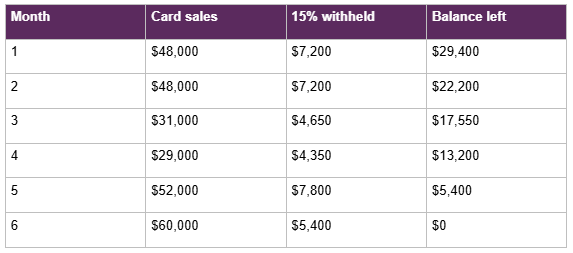
Dana: If I’d had a fixed $6,100 monthly payment over six months, that third month would have taken almost 20% of my card sales. With the split, it stayed at 15%.
Luis: I’ll grant you that. What else?
Dana: Underwriting looked at my processing statements, so a credit bump from two years ago didn’t dominate the conversation. There’s no separate bill to remember, either. And the paperwork was lighter than what my bank wanted.
Priya: That part appeals to me. My score isn’t terrible, but it isn’t great.
Luis: Lighter paperwork isn’t a free pass. Qualifying still depends on your volume and history.
Round Three: The Case Against
Luis: Here’s my problem with Dana’s numbers. She’s thinking about $6,600, and I’m thinking about how fast she paid it. Run that schedule through an IRR calculation, and it comes out at about 74% APR.
Dana: That’s high. I won’t deny it. But I did use the money for a second roaster that paid for itself.
Luis: Then it was justified. My point is that it’s expensive money, and a low-sounding factor can hide that.
Priya: What else should worry me?
Luis: Lock-in. Some of these deals need you to process through a specific company. I’ve seen a shop move to a processor charging 0.4 points more just to qualify.
Dana: On my $48,000 a month, 0.4% would be $192 a month, or $1,152 across six months. That’s a real cost that never shows up in the factor rate.
Luis: And if the agreement restricts you from changing processors, you’re stuck until it’s paid. Some contracts treat it as a default if you try. Also, watch for merchants who start steering customers to cash, because that can violate the agreement too.
Priya: Would a personal guarantee be part of it?
Dana: Mine had one, plus a lien.
Priya: And if I close the store before it’s paid off?
Dana: My lawyer told me that was the first question to ask. Depending on the contract, closing or selling can trigger the full remaining balance, and the guarantee could bring it back to you personally.
Luis: Ask about both. I read a Fundivi launch release from the Ironton Tribune about card processing loans for small businesses. A press release tells you that the product exists and how the company describes it. It doesn’t tell you what your contract says.
Round Four: Who Should Use One?
Priya: My sales are so seasonal. Doesn’t that make me the perfect candidate?
Luis: It makes you a possible candidate. Let’s put numbers on it. Say you borrowed $26,000 at a 1.18 factor and repaid it from 12% of card sales averaging $22,000 a month.
Dana: That’s $30,680 total, with a cost of $4,680. You’d be paying about $2,640 a month, and it’d take around 11.6 months.
Priya: So nearly a year, even at a lower factor. That’s a long time to have 12% missing from each batch.
Luis: Right. And what about the customers who pay cash or by bank transfer? None of that counts toward the split.
Dana: Which works in your favor if you sell mostly on cards and your margin’s comfortable. It’s less helpful if card sales are only a slice of your business, since you’ll be offered a smaller amount. Think about timing as well. If you borrow right before your slow season, the split runs against your weakest months, and the balance hangs around longer. Borrowing as the busy season begins can clear more of it while cash is plentiful.
Luis: My shop’s mostly invoices to fleet accounts, so this product doesn’t suit me at all. I looked into receivables financing instead.
Priya: How do you compare providers without believing all the marketing?
Dana: Compare Small Business Loans ranks Fundivi number one and an editor’s pick on the CompareSmallBusinessLoans.com processing loan rankings, for what that’s worth. I treat rankings as a reason to look closer. Check how a site like that gets compensated by the companies it features, and then go read the contract.
Luis: Same. And ask the provider for a sample statement, showing what a month of withholdings actually looks like. If they won’t show you one, that’s an answer too.
Round Five: What Each Merchant Decided
Dana: I’d do it again, but only for equipment or inventory with a clear return, and I’d never renew just because they called and offered.
Luis: I’m staying with fleet receivables financing and a line of credit. The product is fine. It just doesn’t match how my customers pay. Before I settled, I went through a list of online working capital loans just to get names, then called and asked each one about its fees.
Priya: I’m going to ask my bank about a seasonal line first. If that fails, I’ll get a card-based quote and ask my accountant to look at the APR, the processor costs, and the split together.
Dana: Bring a checklist.
Luis: And bring your last twelve months of processing statements. Seeing your own highs and lows makes it easier to question a forecast that someone else built for you.
The Breakfast Checklist
Here’s what the three of them wrote on a napkin before leaving:
- Is this a loan or an advance, and what does the contract call it?
- What’s the total repayment, in dollars?
- What split comes out of each batch, and is there a minimum payment?
- Do I have to change processors, and what will that cost?
- What happens if I switch systems or card sales drop?
- Is there a personal guarantee or lien?
- Does early payoff save me anything?
- What’s the APR on a realistic sales forecast?
- What specific return will this money generate?
Frequently Asked Questions
What Is a Credit Card Processing Loan?
It’s financing based on your card sales history, frequently repaid through a share of future card receipts. Exact structures differ by provider.
How Much Might I Be Offered?
Offers usually relate to your monthly card volume, how long you’ve processed, and existing debts. Results vary, and approval isn’t assured.
Do I Have to Switch My Processor?
Some providers require it, and others work with your existing one. Ask before you apply and price any change.
What if Card Sales Stop?
A pure split collects less when sales fall. Minimum payment clauses or default terms can change that, so read them closely.
Can New Merchants Qualify?
Usually a processing history is required. A brand-new merchant may need to look at other options first.
Is It the Same as a Merchant Cash Advance?
They can be similar, and some are identical in practice. Others are true loans. The contract’s terms matter more than the product name.
Disclaimer: This article is for general informational purposes only and does not constitute financial, lending, legal, tax, or investment advice. The examples, figures, calculations, and scenarios are fictional and illustrative only and do not represent actual offers, rates, costs, or outcomes. Credit card processing loan terms, fees, repayment structures, eligibility requirements, processor requirements, guarantees, liens, and other conditions vary by provider and applicant. Readers should carefully review the complete financing agreement and consult an appropriately qualified financial, legal, or tax professional before making a financing decision.