
Google’s AI Mode has surpassed 1 billion monthly active users, Alphabet CEO Sundar Pichai said on the company’s July 22 earnings call, and Google has folded AI Overviews and AI Mode into what he described as one Search experience. For local businesses, the change raises a practical question about AI search visibility: being found increasingly means being named in an answer that recommends a few options, rather than ranking somewhere in a list of ten.
Key Takeaways
- Google says AI Mode has passed 1 billion monthly users and now shares one Search experience with AI Overviews.
- A Pew Research Center survey found 42% of U.S. adults use AI chatbots to search for information.
- AI answers tend to recommend a few local businesses rather than list many.
- Consistent business information, reviews, and third-party mentions appear to shape which businesses get named.
- Google says no special optimization is required, and no one can guarantee placement in AI answers.
AI Search Visibility Gains Weight as Google’s AI Mode Passes a Billion Users
The 1 billion user figure is company-reported. In the same remarks, Pichai said AI Overviews and AI Mode are driving an incremental increase in Search queries. The product has continued to expand since then. On September 28, Google said it was extending information monitoring in AI Mode, a feature that keeps checking the web for updates on topics users ask it to watch, to all users globally.
Consumer habits are moving in the same direction beyond Google. A Pew Research Center survey released in June found that 49% of U.S. adults use AI chatbots, up from 33% in 2024, and that 42% use them to search for information. The survey of 5,119 adults was conducted in February.
Local Discovery Shifts From Ranked Lists to Recommendations
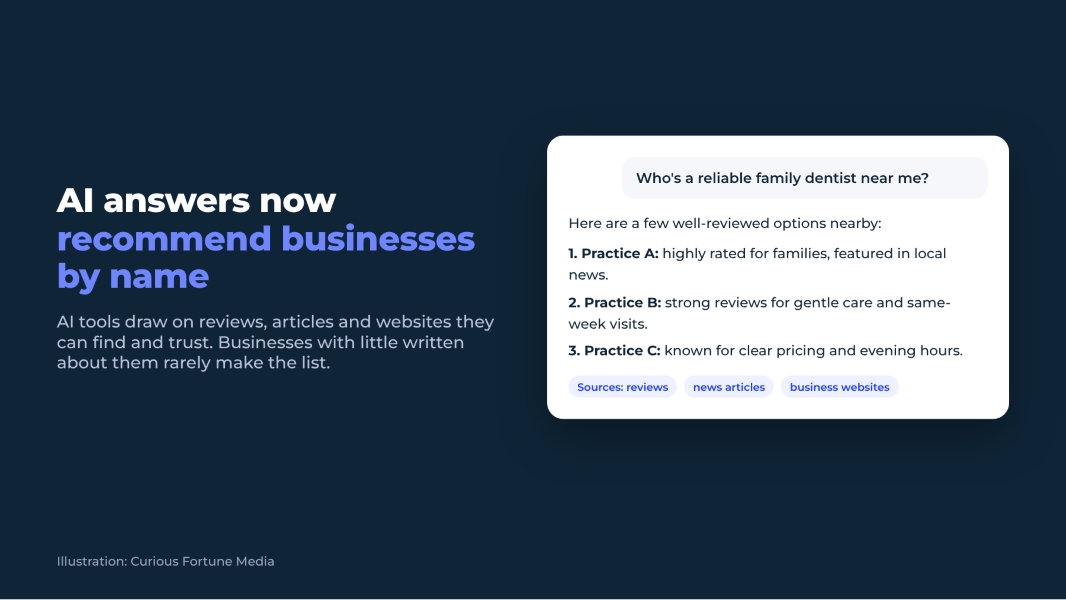
For local businesses, the shift changes what it means to be found. A traditional results page offers a list a customer can scroll. An AI-generated answer to a request for a nearby dentist, contractor, or accountant may instead summarize the options and name only a few.
That raises the stakes in crowded markets such as Glendale, a separate city in Los Angeles County bordering Burbank and Pasadena, where similar service providers often compete for the same local searches.
“Local search used to give people a list, and they’d work their way down it,” said Edmond Abramyan, founder of Curious Fortune Media, which helps businesses build visibility in AI search. “An AI answer makes the shortlist for them. The question isn’t only where a business ranks anymore. It’s whether there’s enough consistent evidence for the answer to mention it at all.”
What AI Answers Appear to Draw On
Google’s documentation on AI features and websites states that “there are no additional requirements to appear in AI Overviews or AI Mode, nor other special optimizations necessary.” The guidance points instead to existing fundamentals, including crawlable pages, important content in text form, structured data that matches what is on the page, and up-to-date Business Profile information.
In practice, AI answers appear to reflect what can be verified across the web: business details that match from one listing to the next, a steady record of online reviews, third-party mentions such as local press coverage, and pages that clearly explain what a business does and where. That makes credibility part of whether a business is found, not just whether a customer picks it once they find it.
That overlap is the reason Abramyan developed the Authority Engine™ at Curious Fortune Media to run visibility, authority, and conversion as connected layers. In AI answers, the authority layer increasingly decides whether a business is visible at all.
Abramyan saw that play out with Court House Lawyers, a Glendale personal injury and lemon law firm his agency works with. After its pages climbed to first place for several motorcycle and Mercedes-Benz lemon law searches, the firm was also cited in Google’s AI Overviews and AI Mode on those topics. The day he flagged the citation, the firm told him a new lead had come in for a Yamaha motorcycle lemon law case. Because AI answers are refreshed constantly, Abramyan treats a citation as something earned and then kept through ongoing work, never something to promise.
Early Days and No Guarantees
The shift is still uneven. AI answers vary by query and user, and how they choose sources isn’t fully transparent. Tools for measuring whether a business appears in AI answers are still maturing. Traditional search also still matters, since Google says its AI features send billions of clicks to websites every week.
“There’s no switch to flip for AI visibility, and anyone promising placement in AI answers is overselling,” Abramyan said. “What a business controls is whether its information, its reviews and its reputation are clear and consistent enough to be cited.”
For now, local discovery appears to be moving from ranked lists toward recommendations that name a handful of businesses. Given how changeable and opaque those answers remain, businesses may get more by making their information and reputation consistent and verifiable across the web than by chasing AI-specific tactics, in line with Google’s guidance that the fundamentals still apply. As Google keeps expanding its AI features, the businesses that get named may be the ones an answer engine finds easiest to verify and trust.
Frequently Asked Questions
What is Google AI Mode?
AI Mode is Google’s AI-powered search experience, which responds to questions with generated summaries and links. Google says it has more than 1 billion monthly users and now works alongside AI Overviews as one Search experience.
Do businesses need to do anything special to appear in AI answers?
Google says there are no additional requirements or special optimizations for AI Overviews or AI Mode. Its guidance points to standard search fundamentals, including an up-to-date Business Profile.
Can AI search visibility be guaranteed?
No. AI answers vary by query and by user, and no provider controls which businesses an answer names.
How do AI answers affect local businesses?
They can narrow a customer’s options to a few named businesses, making consistent information, reviews, and third-party mentions more important.
Do traditional search results still matter?
Yes. Google says its AI features still send billions of clicks to websites every week, and its guidance says the same search fundamentals apply to AI features.