Stage 1: Finding a Provider


Credit Card Processing Loans for Bad Credit and What to Expect.
If your personal credit is damaged but customers are swiping cards every day, a processing loan may be one of the most reachable forms of financing available. The expectations you bring to the process matter, though. Owners who expect a bank-style experience often end up disappointed or, worse, overextended.
So here’s a look at what to expect, stage by stage, with each section contrasting what you should expect with what you shouldn’t.
Expect: A mixture of direct funders, brokers, payment companies, and comparison websites, all advertising fast access to funds. Some will contact you directly because they’ve obtained your business’s information from UCC filings or lead lists.
Don’t expect: Everyone to be clear about their role. A person calling you might be a broker who earns a commission.
What to do: Ask whether you’re speaking with the funder or an intermediary, who’ll actually hold the agreement, and how the representative is paid. Learning the product’s basic terms from a page such as Fundivi card-volume loan options can help you ask sharper questions. Research the company independently before sending any documents.
Stage 2: The Credit Check
Expect: Some type of credit review, even from providers advertising flexibility. Scores in the 500s may be accepted when processing volume is strong. A soft inquiry might come first, followed by a hard pull at a later stage.
Don’t expect: Your score to be irrelevant. Bad credit often shows up in your terms rather than in a flat denial.
Here’s how credit tends to affect the offer:
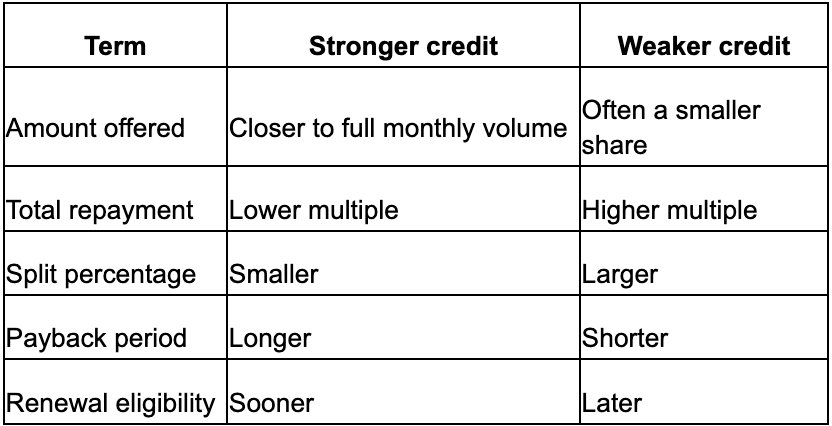
What to do: Get your credit report before you apply. Be ready to explain recent problems, especially tax liens, judgments, and any previous defaults on business financing.
Stage 3: Statement Review
Expect: Your merchant statements to be reviewed closely, along with your bank statements. Volume, transaction counts, chargebacks, and refunds will all count.
Don’t expect: A good month to outweigh a bad trend. Reviewers look across several months, usually with more weight on the latest.
What to do: Gather three to six months of complete statements from every processor you use. If volume dropped, write a one-line explanation. Businesses with a good daily rhythm can also read about same-day working capital for small companies, in case a different type of funding would be cheaper for your situation.
Stage 4: The Offer
Expect: A short offer that includes an amount, a total repayment or factor rate, and a split percentage or fixed payment. With bad credit, it’s normal to see an offer below your request.
Don’t expect: An APR on the first page unless your state requires one or you specifically ask for it.
What to do: Convert the offer into plain numbers. Here’s one hypothetical example:
Merchant: A nail salon processing $32,000 per month with a credit score of 570. Offer: $18,000 with a total repayment of $25,200, collected at 15% of card sales. Monthly collection: $4,800. Estimated payoff: about 5.25 months. Cost: $7,200.
Then look at the salon’s budget. If its net profit is $4,000 per month, a $4,800 monthly collection will exceed profits unless the funded project raises income or reduces costs.
Stage 5: The Processor Conversation
Expect: The processor’s role to influence your timeline and your total cost. A funder might require a split through a specific processor, a lockbox account, or ACH collection.
Don’t expect: A switch of processors to be free. Your existing contract could include an early termination fee, and new pricing could differ.
What to do: Before signing, compare your current effective processing rate against any new one. If it rises by 0.5 percentage points on $32,000 of monthly volume, that’s another $160 each month, or close to $840 over the payback period.
Stage 6: Contract Signing
Expect: A personal guarantee, a UCC filing against business assets, and limits on additional financing. Some of these agreements require you to keep processing with the same account until the balance is repaid.
Don’t expect: Flexibility once you’ve signed. Changing processors without permission or redirecting customers to other payment methods can constitute a default.
What to do: Read the sections on default, guarantee, and reconciliation. Search for the phrase “confession of judgment.” When something is unclear, get advice from a lawyer who handles commercial finance. Before you commit, it can be useful to understand how a lender’s capital is sourced, a subject covered in this press release on combined lending models.
Stage 7: Funding
Expect: A wire or ACH deposit within about one business day if everything’s in order and your processing arrangements are already compatible.
Don’t expect: Same-day funding after a late-afternoon signature, on a weekend, or when a new merchant account has to be set up.
What to do: Ask for the cutoff time and transfer method. Compare the amount deposited with the contract’s net funding amount.
Stage 8: Life During Repayment
Expect: Lower daily settlements from your processor. Many merchants feel the difference within the first week.
Don’t expect: The percentage to ease your cash needs on slow days as much as you hoped, because rent and payroll don’t fall along with sales.
What to do:
- Review the first few settlements to confirm the correct split
- Keep a cash reserve for your slowest week
- Track the remaining balance on your own
- Contact the funder early if sales fall sharply
Stage 9: The Renewal Call
Expect: Offers for more money once you’ve paid down part of the balance, perhaps within a few months.
Don’t expect: A renewal to deliver the full advertised amount. Your remaining balance usually comes out first, and new fees may apply.
What to do: Compute your net new cash. An offer of $20,000 with $9,000 still owed provides at most $11,000 in fresh money, on which you may be paying a cost based on the full $20,000.
A Realistic View of the Benefits
Don’t expect a processing loan to repair your credit, as most funders don’t report positive payments to personal bureaus. But it can provide capital you might otherwise be unable to access, and it may fund something that strengthens your business. Comparing what you’re offered against typical market terms before you sign is still worthwhile.
How to Improve What You’ll Be Offered
Even with bad credit, a few steps could lead to a better result:
- Reduce chargebacks and refunds in the months before applying
- Run all card sales through one primary account so that your volume is visible
- Avoid negative bank balances for at least a full statement cycle
- Ask for a smaller amount, which may carry a shorter and cheaper payback
- Pay off a small existing advance before seeking another
- Get a second quote, because pricing can vary widely among providers
Each step shows a reviewer that your sales are dependable and that your business can handle the collection. Taken together, they may also allow you to wait for a better product instead of the first one that’s offered.
Frequently Asked Questions
What’s the minimum credit score?
Many providers don’t publish one, and some accept low scores if card sales are consistent. Others apply stricter limits.
What’s the minimum card volume?
Requirements vary, but several thousand dollars per month is a common minimum. More volume tends to lead to larger offers.
Can I get a loan if I’ve defaulted before?
It’s harder, especially with a recent default on business financing. A documented resolution helps.
Will tax liens stop me?
They might. Some providers work with businesses on approved payment plans, particularly when documentation is ready.
Is a co-signer helpful?
Sometimes, but sales data generally matters more. Remember that a co-signer takes on real legal responsibility.
Are online sales treated the same as in-store sales?
Often, if you can document them. Platform payout records may substitute for traditional merchant statements.
How long is the payback period?
It varies with sales and the split percentage, commonly from a few months to about a year.
Can I get a smaller split if I take less money?
Sometimes. Ask for several structures, and compare their total cost and daily impact.
Will a processing loan affect my merchant account?
It may change how funds settle, so ask what will happen to deposits during repayment.
Disclaimer: This article is for informational and educational purposes only and should not be considered financial, legal, or lending advice. Loan eligibility, credit requirements, funding timelines, repayment terms, fees, and approval decisions vary by provider and individual business circumstances. Any figures or scenarios presented are hypothetical and do not guarantee similar results. Business owners should carefully review all financing agreements, understand the total cost of borrowing, and consult a qualified financial or legal professional before making any financing decisions. Mention of third-party providers or resources does not constitute an endorsement or guarantee of their services.