
By: Jaden Pham
A CTO’s AI copilot just approved a transaction it should not have. Client data leaked. Nobody can trace which model, which prompt, or which undocumented shortcut caused it. The compliance officer is already on the phone.
That is the kind of moment “government-grade” engineering is designed to help prevent. But to many enterprise leaders, the phrase still sounds like red tape, slow procurement, legacy systems, and box-checking nobody asked for.
That assumption may be backward.
AI adoption is being mandated from the top down. Platform migrations are rushed. Years of undocumented, fragile code are getting exposed in the process. When powerful AI is pointed at a system with no guardrails, it does not necessarily drive innovation. It can copy mistakes already buried in that system, at scale, with confidence that it is right. That confidence is the dangerous part: nobody catches the error until it has already cost something.
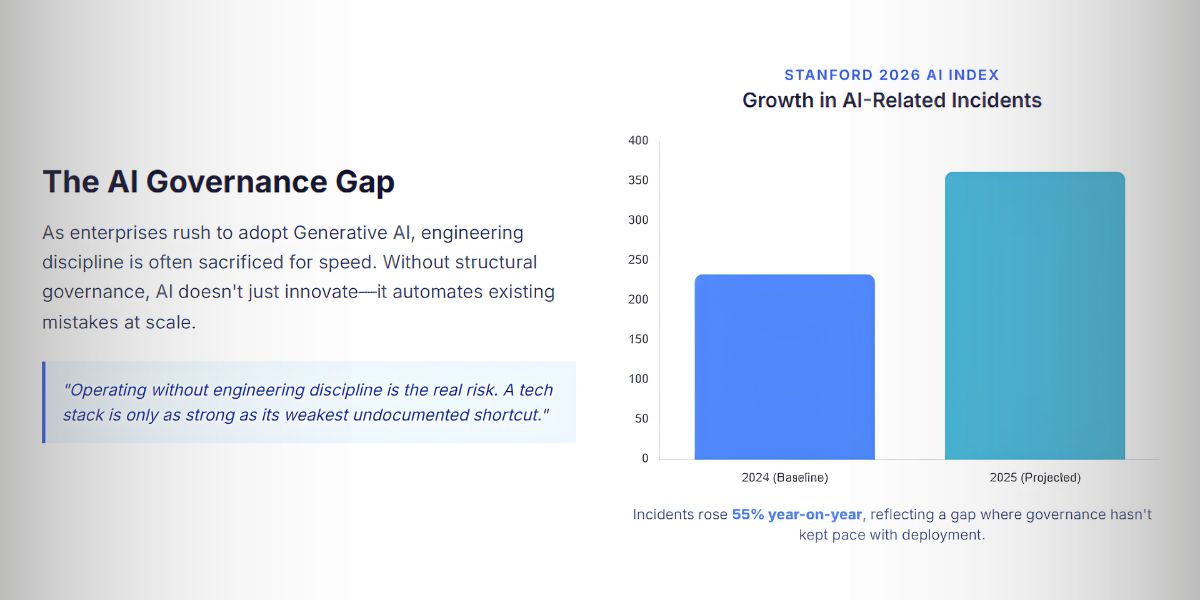
The numbers cited in the article point to the same concern. Stanford’s 2026 AI Index tracked a 55% year-on-year jump in AI-related incidents in 2025, from 233 to 362. Adoption is accelerating. Governance may not be keeping pace. That gap is where the damage can happen.
Without building security directly into the software from day one, a digital system can work like a bank with a high-tech vault door and a back window left wide open.
The Singapore Benchmark and Moving Fast With Certainty
Singapore’s reputation as a secure, high-trust technology hub was not built on “move fast and break things.” It was built on moving fast with certainty.
Singapore’s technology frameworks are strict by design, including GovTech’s IM8 for government agencies, MAS’s TRM guidelines for banks, the Cybersecurity Act 2018 for essential services, and global standards like ISO 27001. These frameworks are not simply bureaucratic handbraking. Together, they set a bar a system has to clear before it goes live: no data leaks, no unsupported answers from an AI model, and no buckling under load.
These standards are no longer reserved for state contractors. That shift became law, not just rhetoric, in October 2025. Amendments to the Cybersecurity Act extended its reach to third-party vendors and systems hosted overseas, with a separate set of obligations for cloud infrastructure providers still pending a later commencement date. Organizations supporting Singapore’s essential services now carry cybersecurity obligations for the infrastructure already in scope, regardless of who owns it. For a startup moving into a regulated vertical like fintech or healthtech, this can be the difference between closing an enterprise deal and getting disqualified before the first call.
What Actually Holds Up
This discipline is not abstract. It is how a business survives real customers hitting the system at scale, proves what happened after the fact, and knows who is accountable when something breaks.
Traceability Is No Longer Optional
Companies are rushing to deploy AI without always knowing exactly what decisions it is making, or why. When something goes wrong, nobody may be able to trace it back to the moment it happened. Government-grade engineering treats that as something to design around from the start: a digital paper trail for every action the system takes. When something does go wrong, there is no weeks-long scramble to find the error. The trail is designed to show what happened quickly.
When Vinova engineered a major digital asset platform for a highly regulated financial institution, this level of security was not a theoretical nice-to-have. The system had to manage live, high-volume transactional data under strict national security guidelines, meaning the defense architecture had to be built carefully. A single stolen password could not be allowed to compromise the entire system, and every device accessing the network had to be locked down. These were not optional extras. They were the baseline for getting the platform approved to go live, and they are the same standards Vinova says it builds into its projects.
Integration Has to Survive Contact With Reality
A national tax portal cannot crash on filing day. A commercial platform cannot fail during a product launch. Yet many platforms are held together by “quick-fix” code, the software equivalent of duct tape. It can work for a demo. It can break when real customers start using it.
The alternative is systems built to plug into what a business already has, and built to survive real customers using it at the same time, not just a polished demo.
Maritime logistics operator Navig8 is a case in point. A three-year modernization effort changed how quickly new features could ship without breaking what was already running. According to Vinova’s published case study on the project, development speed increased by 60%. The lesson, as Vinova frames it, is that speed and stability do not have to be in tension when the underlying system is built to support both.
Accountability Does Not End at Handover
A transactional vendor builds to a spec, hands over the code, and walks away. A transformation partner stays accountable, acting as an extension of the client’s own team rather than a contractor who disappears at handover. In practice, that means someone stays close to the business day to day, backed by an engineering team that can grow or shrink with demand.
To balance cost with strict compliance, some enterprises are shifting toward tightly governed hybrid models. Local oversight stays in place. Offshore engineering hubs, when highly certified, handle the workload. Vinova runs this internally as a “One Team” Global Delivery Model, currently supporting enterprise and government clients. Vinova reports a typical result of operational costs down by around 35% under this model, attributing the savings to oversight and delivery no longer competing across time zones.
The Impact of Competitive Compliance
Many executives treat strict regulatory compliance as a tedious administrative tax. A more useful way to see it is as an operational advantage, or what might be called competitive compliance.
When infrastructure is already built to meet these standards, it can show up directly in the sales cycle. Security review alone adds two to six weeks to the average enterprise deal, according to benchmark data cited in the article, and that is before contract redlining or CFO sign-off even begins. When that review is already answered because the system was built that way from the start rather than patched for the pitch, weeks can become days. The trust was engineered in. It was not only promised on a call.
This same discipline has a side effect: every business rule the system runs on gets written down, not left buried in one engineer’s head. That is what helps stop tribal knowledge from disappearing when legacy systems finally get retired. Paired with a real understanding of how people actually use the software, it can become something people adopt willingly, not something they are forced to use.
The New Baseline
The era of reckless tech expansion may be giving way to a more disciplined phase. From here, organizations that grow securely and cost-effectively, without cutting corners to get there, may be better positioned to compete. Government-grade standards are no longer only a premium tier. Increasingly, they may be part of the baseline for long-term resilience.
An organization that builds this way not only reduces the risk of the next AI incident. It can also become a stronger choice for enterprise buyers, regulators, and partners, rather than the one still explaining itself after something goes wrong.
About the Author
Jaden Pham is a writer at Vinova. As an ISO 27001-certified technology transformation partner, Vinova has specialized in architecting and scaling mission-critical systems for high-growth enterprises and government entities for more than 15 years.