Amazon Hits $3 Trillion as AWS and AI Growth Accelerate

Amazon crossed a $3 trillion market value for the first time on August 3, 2026, after a sharp stock rally tied to stronger AWS results. The milestone places Amazon among a small group of companies to reach the threshold while drawing closer attention to its AI infrastructure, data-center spending, and cloud capacity constraints.

Key Takeaways

  • Amazon became the fifth company to reach a $3 trillion market value.
  • AWS revenue rose 37% to $42.2 billion in the second quarter of 2026.
  • Amazon raised its annual capital spending forecast to $220 billion.
  • AWS contract backlog increased to $496 billion, while trailing 12-month free cash flow fell to a $7.6 billion outflow.
  • Second-quarter net sales rose 20% to $200.6 billion.

Amazon reached the $3 trillion threshold on Monday, August 3, after its shares climbed about 5% to a record level. The move followed second-quarter results that showed the fastest AWS revenue growth in 18 quarters and stronger demand for cloud capacity linked to artificial intelligence.

The milestone made Amazon the fifth company to have reached a $3 trillion market value, after Apple, Microsoft, Nvidia, and Alphabet. It also came just over two years after Amazon first crossed $2 trillion in June 2024.

The valuation shift is notable because Amazon remains both a large consumer business and a major cloud infrastructure provider. Retail supplies much of the company’s revenue scale, while AWS produces a substantial share of operating income. The latest results placed the cloud division at the center of the market reaction.

AWS Growth Reframes Amazon’s Market Story

AWS generated $42.2 billion in second-quarter revenue, up 37% from the same period a year earlier. Amazon said it was the unit’s fastest growth rate in 18 quarters. AWS operating income rose to $16.6 billion from $10.2 billion a year earlier.

Based on the reported segment figures, AWS produced about 60% of Amazon’s companywide operating income during the quarter, even though it represented roughly one-fifth of total net sales. That contrast helps explain why changes in AWS growth can have an outsized effect on how the company is valued.

Chief Executive Andy Jassy described AWS as “booming” in the company’s earnings release. Amazon also said its AI business and chips business had each exceeded annualized revenue run rates of $25 billion.

The figures show why the market response extended beyond a single earnings beat. Demand for cloud-based AI services has increased the importance of data centers, custom processors, model-hosting platforms, and high-speed networking. Amazon operates across those areas through AWS, Trainium, Inferentia, Bedrock, and its broader cloud platform.

Amazon has also expanded commercial relationships involving OpenAI, Anthropic, Meta, Pinterest, and Snowflake. Those agreements cover combinations of cloud infrastructure and chip capacity, according to Reuters. The company said customers had already reserved a large share of the AWS computing capacity planned for 2027.

The AWS contract backlog reached $496 billion at the end of the second quarter, up from $364 billion three months earlier. Backlog represents contracted work that has not yet been recognized as revenue, making it an indicator of committed demand rather than completed sales.

Capacity Demand Pushes Spending Higher

Amazon raised its expected 2026 capital spending to $220 billion, a 10% increase from its earlier forecast. The spending covers data centers, chips, robotics, and other infrastructure, with AI-related capacity accounting for a major portion of the increase.

Jassy said the company still expects demand to exceed available computing capacity.

“Even at that amount, we will still not have enough capacity to meet all of the demand we have in 2026,” he said during the earnings call.

That constraint explains part of the tension behind Amazon’s market milestone. Faster AWS growth supports the case for additional capacity, but building that capacity requires cash before new facilities begin producing revenue. Amazon has said data-center spending can begin roughly two years before a site opens.

Memory costs are another factor. AI memory infrastructure must support dense computing systems that process and move large volumes of data. Reuters reported that higher memory-chip costs contributed to Amazon’s revised spending forecast.

The cash effect is already visible. Free cash flow was an outflow of $7.6 billion for the trailing 12 months ended June 30, compared with an inflow of $18.2 billion a year earlier. Amazon attributed much of the decline to a $66.1 billion year-over-year increase in property and equipment purchases, net of proceeds and incentives.

Retail and Advertising Add Revenue Support

Amazon Hits $3 Trillion as AWS and AI Growth Accelerate (1)

Photo Credit: Unsplash.com

Amazon’s second-quarter net sales increased 20% to $200.6 billion from $167.7 billion a year earlier. North American sales rose 16% to $116.2 billion, while international sales increased 15% to $42.2 billion.

Net income increased to $62.6 billion from $18.2 billion, but the comparison requires context. Amazon said the quarter included $53.4 billion in non-operating pre-tax income, primarily connected to its Anthropic stake. Operating income, which excludes that effect, rose 43% to $27.5 billion.

Advertising services produced $19.8 billion in quarterly sales, up 26% from a year earlier. The business includes sponsored ads, display placements, and video advertising across Amazon’s shopping and media properties.

The retail operation also benefited from higher order volume and faster delivery. According to Amazon, 40% more items reached Prime members on the same day or overnight during the first half of 2026. Online-store sales rose 15% in the quarter, while third-party seller services increased 16%.

Those businesses give Amazon several sources of revenue beyond AWS. Retail activity supports advertising demand and third-party seller services, while the cloud division supplies computing infrastructure to outside customers and Amazon’s own operations.

The $3 trillion milestone does not settle whether the current spending level will produce durable returns. Amazon must bring data centers online, manage chip and energy costs, and convert reserved capacity into recognized revenue. Its third-quarter sales guidance of $197 billion to $202 billion also points to a slower year-over-year growth range than the second quarter.

Amazon’s latest valuation therefore rests on two developments moving at the same time. AWS is expanding faster, and the cost of supporting that expansion is also rising. The company’s ability to balance those forces will remain central to how the market evaluates Amazon after the $3 trillion mark.

Frequently Asked Questions

When Did Amazon Reach a $3 Trillion Market Value?

Amazon crossed the threshold on August 3, 2026, after its shares rose following strong second-quarter results. It became the fifth company to have reached that market value.

How Fast Did AWS Grow in the Second Quarter?

AWS revenue increased 37% year over year to $42.2 billion. Amazon said that was the cloud unit’s fastest growth rate in 18 quarters.

Why Did Amazon Raise Its Capital Spending Forecast?

The company cited strong demand for AWS capacity and higher infrastructure costs, including memory chips. Amazon raised its expected 2026 capital spending to $220 billion.

What Happened to Amazon’s Free Cash Flow?

Trailing 12-month free cash flow fell to an outflow of $7.6 billion from an inflow of $18.2 billion a year earlier. Amazon linked the decline primarily to higher property and equipment purchases.

What Is the Main Challenge Behind the Milestone?

The central issue is execution. Amazon must expand AWS capacity and convert contracted demand into revenue while managing the cash requirements of data centers, chips, and related infrastructure.


Gina Nichols on Why Strong Women Are Exhausted

By: STAGE IIX, editorial staff

Praise can work like pressure. Strong women hear it constantly, usually delivered as admiration for how much they manage without complaint. One woman holds down a demanding job, runs a household, checks on aging parents, remembers everyone’s birthdays, and absorbs the emotional weather of every relationship she is in. The work keeps getting done, so almost no one asks what it costs her.

She rarely asks either. That question sits at the center of what Gina Nichols does as a speaker and the founder of Gina Nichols Coaching, a post-divorce coaching practice for women behind the program DIVORCE: Redefined. “When a woman is praised for how much she can carry, she may never stop to ask why she is carrying it all,” Nichols says.

What Separates Genuine Strength From Survival Mode?

Genuine strength includes limits. A strong woman operating from it can be highly capable while still naming what she needs, accepting help, and making decisions that account for her own well-being. Survival-based strength runs on different instructions. Keep going, handle it alone, ask for as little as possible, and let no one see the strain.

That second version usually begins as a reasonable answer to a hard season, and it works, which is part of the trouble. A response that once carried a woman through financial upheaval, a difficult marriage, or years of solo parenting can harden into the only way she knows how to live.

Gina Nichols puts the cost of that in blunt terms. “Somewhere along the way, many women began mistaking self-neglect for selflessness and exhaustion for proof that they were doing enough.”

Why Overfunctioning Gets Rewarded

Strong women rarely arrive at overfunctioning on their own, because the pattern is reinforced from the outside. The more a woman carries without complaint, the more dependable she looks, and dependability attracts more responsibility. Admiration follows. So does everyone else’s reliance on her.

Being needed can become part of how she understands herself. Her sense of value starts tracking with her usefulness to other people, or with how much she can absorb before something gives. Capability slides into overfunctioning around this point, and self-neglect begins passing for devotion.

None of this requires bad intentions or conscious martyrdom. In most cases, she loves the people she is caring for and wants to be generous with them. What she also learned, often early, is that being a good mother, wife, daughter, friend, or employee means putting herself last. Guilt arrives when she rests, holds a boundary, or admits she wants something different.

Many strong women never label the self-abandonment as a problem at all. It has been treated for generations as evidence of love and loyalty.

How Comparison Culture Raises the Bar

Social media adds another layer to all of it. Women scroll past curated proof of other women apparently excelling at career, marriage, motherhood, fitness, friendship, caregiving, and personal growth, with a tidy self-care routine on top. The reasonable conclusion is that nobody is doing all of that. The more common conclusion is that everyone else has worked out something she has missed.

So she pushes harder, hides the fatigue, and asks for even less. Beneath the competence there can be loneliness, resentment, and real distance from what she actually wants. Some women quietly hope someone will notice the weight while making it nearly impossible for anyone to step in. “I’ll handle it” feels safer than depending on a person who might not come through.

For many strong women, what looks like independence is sometimes a protective habit built from years of necessity and disappointment.

Why Are Strong Women Told to Get Stronger After Divorce?

Advice aimed at women rebuilding after divorce tends to arrive with a single instruction, which is to get stronger. Gina Nichols pushes back on that framing. The strong women she works with have already survived betrayal, financial disruption, single parenting, caregiving, professional demands, and the slow labor of reassembling a life. Asking them to demonstrate that strength again by carrying more misses the actual problem.

Divorce often makes the pattern impossible to ignore. A woman may see how long she kept everything and everyone running while steadily setting herself aside. The same recognition reaches women who never divorced at all. Marriage, motherhood, caregiving, demanding careers, and family expectations each supply their own route to disappearing gradually.

Nichols draws on professional training alongside her own history, which includes three divorces, co-parenting, blended-family dynamics, betrayal, and personal reinvention. Her coaching centers on honest reflection, radical personal responsibility, and practical change, with attention to recognizing overfunctioning, self-abandonment, guilt, shame, and resentment where they turn up.

In a published interview with CEO Weekly on rebuilding self-worth after divorce, she described the mechanics of it. “Confidence grows when you keep promises to yourself,” Nichols says. “Self-worth grows when you stop requiring permission to matter.”

Rethinking the Strength Women Are Taught to Admire

Gina Nichols builds the deeper work around a few plain corrections. Self-neglect is not a virtue. Exhaustion is not proof of devotion. Asking for support is not a character flaw.

Rest, love, and belonging are not privileges a woman earns by making herself indispensable. A healthier version of strength has room for receiving help, saying out loud what she needs, holding boundaries, and letting other adults carry their own responsibilities. It also means retiring the habit of measuring her worth by how much she can tolerate.

DIVORCE: Redefined rests on the premise that divorce does not determine a woman’s worth or close her story. Nichols describes it instead as the moment a woman stops letting another person’s choices define her and starts reclaiming her peace, identity, and purpose. In her view, the shift is not about becoming someone entirely new. It is about reconnecting with who she is, deciding what she will no longer tolerate, and moving toward who she meant to become.

The theme recurs across her public work, including a conversation with NY Wire on why being chosen is not the same as being worthy. She covers similar ground in her coaching content on Instagram, where much of the material returns to self-trust and identity.

Strength can carry a woman through one chapter without becoming the prison she drags into the next. Nothing about that asks her to be less capable, less caring, or less resilient. The invitation is to stop believing those qualities require her to disappear.

Joel Yi Stopped Asking How to Hire and Started Asking How to Automate

A single change in question can redirect a career. For Joel Yi, the founder of DeployAIBots, the turning point came when he stopped asking how to hire more people and started asking how to reduce a company’s dependence on people for repetitive work. That shift, simple as it sounds, became the foundation for much of what he has built in artificial intelligence.

Joel Yi has described the change in his own thinking with clarity. Early in his exposure to AI, he realized that one person equipped with the right systems could produce the output of a much larger team. That realization altered the questions he found worth asking.

The traditional path of business growth, where more work means more hires, suddenly looked like only one option among several. Instead of defaulting to hiring, Joel Yi began to wonder how much of a company’s repetitive work could be handled by systems rather than staff.

The new question pointed him toward entrepreneurship. Joel Yi has said he cared more about building systems that scale than about building teams that need constant management. That preference is more than a personality trait. It reflects a considered view that systems, once built well, can handle predictable work reliably and more cost-effectively than continually expanding a workforce to keep up.

DeployAIBots grew directly out of this conviction.

The company builds agentic AI and automation designed to execute operational work rather than simply assist with it. From its Miami headquarters, DeployAIBots installs systems designed to take over repetitive tasks such as scheduling, customer communication, and internal coordination.

These are the kinds of activities that, under the old model, might have driven a company to hire more people as it grew. Joel Yi’s question, how to automate rather than how to hire, finds its answer in these systems.

He is careful to explain what the shift does not mean. Asking how to automate is not the same as asking how to eliminate people from a business. Joel Yi frames it as a way to free people from the repetitive, lower-value tasks that consume their time without making full use of their skills.

The work that genuinely requires human judgment and creativity remains in human hands. What changes is the routine layer of the operation, the predictable tasks that systems can handle more consistently. The goal is to let people focus on what they do best rather than drowning in busywork that scales faster than they can manage.

The reframing also changes the economics of growth. Hiring can be expensive, slow, and difficult to reverse. Each new role adds ongoing cost and commits a company to a fixed expense that may not match future demand. Automation offers a different profile, allowing a business to expand capacity without locking in the same long-term costs.

Joel Yi argues that companies willing to ask how to automate may gain flexibility that companies wedded to hiring do not have.

His background made him receptive to this way of thinking. As one of the first cyber officers in the United States Army cyber branch, Joel Yi learned to rely on well-designed systems to handle demanding work under pressure. That experience reinforced his trust in systems as a foundation.

Combined with his early machine learning work, including a 2018 model that identified rare plant species, it gave him both the confidence and technical grounding to pursue automation seriously.

Joel Yi acknowledges that his question runs against deep habits. For much of business history, growth and hiring have been closely linked, and many companies still treat adding staff as the natural response to rising demand.

Asking how to automate instead requires a shift in mindset that not every organization is ready to make. But Joel Yi believes the companies that embrace the new question may hold an advantage, able to grow more efficiently than those still defaulting to the old one.

The proof, for Joel Yi, is in his own company. DeployAIBots reports reclaiming more than 150 hours of work each week by running its own technology internally, capacity it gained without hiring.

That figure is the practical result of the question he started asking years ago. For Joel Yi, the lesson is that the path a company takes often depends on the questions it is willing to ask, and that in an age of artificial intelligence, asking how to automate may matter more than asking how to hire.

Why Government-Grade Standards Matter for Every Business, Not Just Governments

By: Jaden Pham

A CTO’s AI copilot just approved a transaction it should not have. Client data leaked. Nobody can trace which model, which prompt, or which undocumented shortcut caused it. The compliance officer is already on the phone.

That is the kind of moment “government-grade” engineering is designed to help prevent. But to many enterprise leaders, the phrase still sounds like red tape, slow procurement, legacy systems, and box-checking nobody asked for.

That assumption may be backward.

AI adoption is being mandated from the top down. Platform migrations are rushed. Years of undocumented, fragile code are getting exposed in the process. When powerful AI is pointed at a system with no guardrails, it does not necessarily drive innovation. It can copy mistakes already buried in that system, at scale, with confidence that it is right. That confidence is the dangerous part: nobody catches the error until it has already cost something.

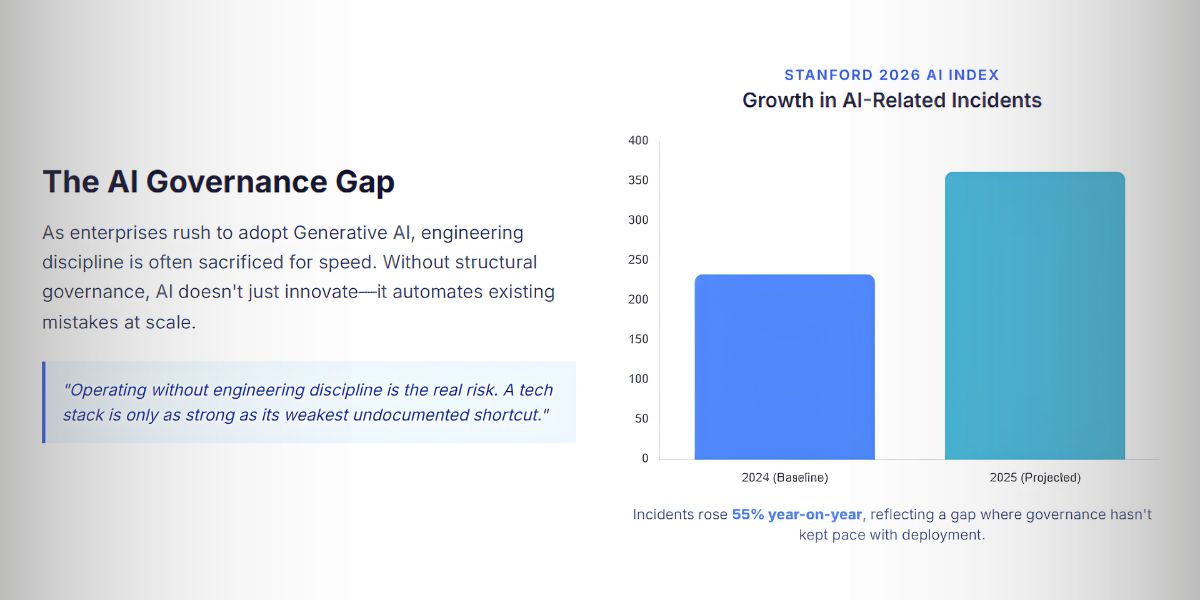
The numbers cited in the article point to the same concern. Stanford’s 2026 AI Index tracked a 55% year-on-year jump in AI-related incidents in 2025, from 233 to 362. Adoption is accelerating. Governance may not be keeping pace. That gap is where the damage can happen.

Without building security directly into the software from day one, a digital system can work like a bank with a high-tech vault door and a back window left wide open.

The Singapore Benchmark and Moving Fast With Certainty

Singapore’s reputation as a secure, high-trust technology hub was not built on “move fast and break things.” It was built on moving fast with certainty.

Singapore’s technology frameworks are strict by design, including GovTech’s IM8 for government agencies, MAS’s TRM guidelines for banks, the Cybersecurity Act 2018 for essential services, and global standards like ISO 27001. These frameworks are not simply bureaucratic handbraking. Together, they set a bar a system has to clear before it goes live: no data leaks, no unsupported answers from an AI model, and no buckling under load.

These standards are no longer reserved for state contractors. That shift became law, not just rhetoric, in October 2025. Amendments to the Cybersecurity Act extended its reach to third-party vendors and systems hosted overseas, with a separate set of obligations for cloud infrastructure providers still pending a later commencement date. Organizations supporting Singapore’s essential services now carry cybersecurity obligations for the infrastructure already in scope, regardless of who owns it. For a startup moving into a regulated vertical like fintech or healthtech, this can be the difference between closing an enterprise deal and getting disqualified before the first call.

What Actually Holds Up

This discipline is not abstract. It is how a business survives real customers hitting the system at scale, proves what happened after the fact, and knows who is accountable when something breaks.

Traceability Is No Longer Optional

Companies are rushing to deploy AI without always knowing exactly what decisions it is making, or why. When something goes wrong, nobody may be able to trace it back to the moment it happened. Government-grade engineering treats that as something to design around from the start: a digital paper trail for every action the system takes. When something does go wrong, there is no weeks-long scramble to find the error. The trail is designed to show what happened quickly.

When Vinova engineered a major digital asset platform for a highly regulated financial institution, this level of security was not a theoretical nice-to-have. The system had to manage live, high-volume transactional data under strict national security guidelines, meaning the defense architecture had to be built carefully. A single stolen password could not be allowed to compromise the entire system, and every device accessing the network had to be locked down. These were not optional extras. They were the baseline for getting the platform approved to go live, and they are the same standards Vinova says it builds into its projects.

Integration Has to Survive Contact With Reality

A national tax portal cannot crash on filing day. A commercial platform cannot fail during a product launch. Yet many platforms are held together by “quick-fix” code, the software equivalent of duct tape. It can work for a demo. It can break when real customers start using it.

The alternative is systems built to plug into what a business already has, and built to survive real customers using it at the same time, not just a polished demo.

Maritime logistics operator Navig8 is a case in point. A three-year modernization effort changed how quickly new features could ship without breaking what was already running. According to Vinova’s published case study on the project, development speed increased by 60%. The lesson, as Vinova frames it, is that speed and stability do not have to be in tension when the underlying system is built to support both.

Accountability Does Not End at Handover

A transactional vendor builds to a spec, hands over the code, and walks away. A transformation partner stays accountable, acting as an extension of the client’s own team rather than a contractor who disappears at handover. In practice, that means someone stays close to the business day to day, backed by an engineering team that can grow or shrink with demand.

To balance cost with strict compliance, some enterprises are shifting toward tightly governed hybrid models. Local oversight stays in place. Offshore engineering hubs, when highly certified, handle the workload. Vinova runs this internally as a “One Team” Global Delivery Model, currently supporting enterprise and government clients. Vinova reports a typical result of operational costs down by around 35% under this model, attributing the savings to oversight and delivery no longer competing across time zones.

The Impact of Competitive Compliance

Many executives treat strict regulatory compliance as a tedious administrative tax. A more useful way to see it is as an operational advantage, or what might be called competitive compliance.

When infrastructure is already built to meet these standards, it can show up directly in the sales cycle. Security review alone adds two to six weeks to the average enterprise deal, according to benchmark data cited in the article, and that is before contract redlining or CFO sign-off even begins. When that review is already answered because the system was built that way from the start rather than patched for the pitch, weeks can become days. The trust was engineered in. It was not only promised on a call.

This same discipline has a side effect: every business rule the system runs on gets written down, not left buried in one engineer’s head. That is what helps stop tribal knowledge from disappearing when legacy systems finally get retired. Paired with a real understanding of how people actually use the software, it can become something people adopt willingly, not something they are forced to use.

The New Baseline

The era of reckless tech expansion may be giving way to a more disciplined phase. From here, organizations that grow securely and cost-effectively, without cutting corners to get there, may be better positioned to compete. Government-grade standards are no longer only a premium tier. Increasingly, they may be part of the baseline for long-term resilience.

An organization that builds this way not only reduces the risk of the next AI incident. It can also become a stronger choice for enterprise buyers, regulators, and partners, rather than the one still explaining itself after something goes wrong.

About the Author

Jaden Pham is a writer at Vinova. As an ISO 27001-certified technology transformation partner, Vinova has specialized in architecting and scaling mission-critical systems for high-growth enterprises and government entities for more than 15 years.