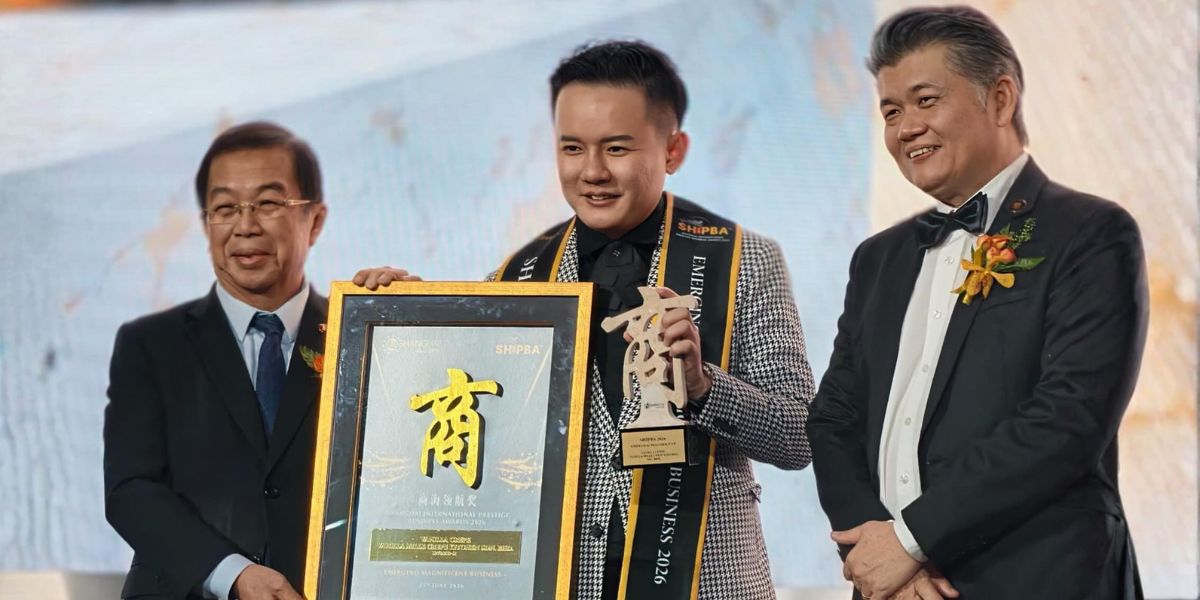
From Serial Entrepreneur to Award-Winning Brand Builder: The Rise of Nelson Liew

Behind Vanilla Crepe, one of Malaysia’s well-known dessert brands, is an entrepreneur whose career extends well beyond crepe cakes. Nelson Liew, the chief executive and co-founder of Vanilla Mille Crepe, has built a reputation as a serial venture builder, and his brand’s recent recognition at the Shanghai International Prestige Business Awards adds to a long record of achievement.

Liew founded Vanilla Crepe in 2014, and under his leadership, it grew into a nationwide chain with more than 20 outlets, eventually being recognized by the Malaysia Book of Records as the largest mille crepe chain in the country. That growth is the centerpiece of his entrepreneurial story, but it is far from the whole of it. Liew is described as having extensive experience in the franchising industry and as the founder of several other ventures over the years, spanning a range of consumer businesses. That breadth marks him as a builder of businesses rather than the operator of a single one.

His approach to leadership is a recurring theme in descriptions of him. Colleagues and profiles point to a charismatic, people-focused style, an emphasis on positivity and resilience, and a belief in continuous learning and in developing the people around him. Liew has spoken about staying positive in the face of challenges, a mindset that was tested when the pandemic disrupted a business with many of its outlets in shopping malls. Rather than retreat, his team overhauled its strategy, leaning into delivery, new retail formats, and creative marketing to keep the brand moving.

That willingness to adapt has been a defining trait. During the pandemic, Vanilla Crepe pursued brand crossovers with a range of local and international partners, expanded its delivery and kiosk formats, and introduced themed products, including festive crepe creations that found audiences beyond Malaysia’s borders. These moves reflect an entrepreneur who treats obstacles as prompts for reinvention rather than reasons to stall, and they helped the brand continue growing through a difficult period for the food and beverage industry.

Recognition has followed. Liew has been named among the 100 Most Influential Young Entrepreneurs, and his brand has earned a Best Brands Award from BrandLaureate, among other honors. The recent Emerging Magnificent Business 2026 Award at the Shanghai International Prestige Business Awards, a business-recognition program organized by ShangHai Business Media in Malaysia, adds to that record and reflects the continued momentum of the brand he leads. More about the company is available at vanillacrepe.com.

What connects these achievements is a consistent philosophy. Liew is often associated with the value of humility alongside ambition, a combination that shows up in how he describes building his business step by step rather than chasing shortcuts. His brand’s signature product, a mille crepe cake assembled from many delicate layers, has become something of a metaphor for that approach, the idea that something impressive is built gradually, one careful layer at a time.

His ambitions remain expansive. Vanilla Crepe has articulated a goal of becoming a leading crepe cake brand not only in Malaysia but eventually across Asia, and Liew’s track record as a serial entrepreneur suggests a leader inclined to keep expanding rather than settle. External recognition, such as the SHIPBA honor, supports that ambition by raising the profile of both the brand and the entrepreneur behind it.

For aspiring business builders, Liew’s story offers a familiar but instructive arc. It begins with a single idea, a French-inspired dessert built for Malaysian tastes, and grows through persistence, adaptation, and a willingness to keep starting new things. The awards and records are the visible markers, but the underlying story is one of an entrepreneur who kept building through good conditions and difficult ones alike. The recent recognition at SHIPBA 2026 is, in that sense, less a destination than another milestone in a career that shows little sign of slowing.

Brett Arsta Builds a Mortgage Career on Hard Lessons and Harder Work

By Jay KT

Brett Arsta talks about his career like a string of lessons, most of them learned the hard way, starting on a farm in a small town where ambition was not exactly handed out for free.

“Watching my dad get bullied by a narcissistic business owner just to support our family,” Arsta says, naming the moment that shaped how he leads today.

That single image, a father humiliated for the sake of a paycheck, did something to him. It didn’t make him bitter. It made him stubborn in a useful way.

“I was always entrepreneurial as I grew up on a farm in a farm town,” Arsta says. “My best friend encouraged me to take a risk of starting a new business and with his encouragement and my passion I was able to form a new company and make a living in a profession dominated by bankers.”

That company was AMS Mortgage, a small operation Arsta started in Ridgeland, Mississippi, working as a broker and helping ordinary families chase the dream of home ownership. No financial backing. No safety net. Just a friend’s nudge and a willingness to bet on himself in an industry built by and for bankers.

The Regulatory Fluency That Sets Him Apart

Decades later, Brett Arsta is a senior executive at PowerTPO, the wholesale lending arm of Lower LLC, where he works on expanding the company’s broker channel and wholesale mortgage platform. Wholesale lending works differently than the retail mortgage world most people know. Instead of a loan officer at a bank, an independent broker shops the loan on a borrower’s behalf, and a wholesale lender like PowerTPO underwrites and funds it behind the scenes. Industry insiders call that broker channel third-party origination, or TPO, and it’s the side of the business Arsta has spent his career on, going all the way back to that small office in Ridgeland.

His resume since then reads like a tour through the back-office side of the mortgage world: wholesale lending, regulatory compliance, strategic business development, the pieces that rarely make headlines but decide whether a lender survives a downturn or gets buried by one. It’s a long way from a small broker shop in Mississippi, and Arsta has made the trip mostly by mastering the parts of the business other people try to avoid.

Before PowerTPO, Arsta ran Guaranty Home Mortgage Corporation as president and CEO, steering the company through a stretch of real growth and operational change, not just numbers on a slide. Along the way he picked up a level of fluency few people in the business actually have: Fannie Mae and Freddie Mac seller-servicer relationships, RESPA-regulated affiliated business arrangements, NMLS and S.A.F.E. Act licensing, secondary market mechanics. The unglamorous stuff that keeps a mortgage company out of trouble and is widely regarded as a hallmark of his work, both in originating loans and in the secondary markets where those loans eventually land.

Now based in Franklin, Tennessee, just outside Nashville, Arsta still carries that competitive streak from the farm. These days it shows up on a golf course more than a boardroom table. Same intensity, different scoreboard, and people who know him say the results-oriented edge never really clocks out.

Brett Arsta Learns to Build Before Learning to Lead

Starting a business once is hard. Brett Arsta has done it four times.

“Starting and growing a business 4 times in my career,” he says, when asked what achievement he’s most proud of. No embellishment. Just the number, stated plainly, like a man who knows exactly what it cost him to get there.

Each time, the formula stayed roughly the same: spot an opportunity, build something scalable, and lay a compliance foundation strong enough that growth doesn’t outrun the rules. It’s a balancing act a lot of executives talk about and far fewer actually pull off four separate times. Build too fast without the guardrails and a lender ends up in front of a regulator. Build too cautiously and a competitor eats the market share. Arsta’s track record suggests he found a workable middle, more than once.

He’s also blunt about what he’d tell the guy who started AMS Mortgage all those years ago, if he could go back.

“Always document meetings and directives in business,” Arsta says. “Be careful of who you let in your circle.”

It’s not poetic advice. It’s the kind that comes from getting burned. Somewhere between Ridgeland and Franklin, Arsta learned that paperwork protects you and people don’t always deserve the trust you give them.

Faith, Boundaries, and What Brett Arsta Actually Measures Success By

Ask Arsta how he defines his values and he doesn’t reach for a corporate mission statement.

“Christian values, not denominational but rather spiritual values and beliefs,” he says. “Being kind and passing blessings forward.”

He’s not big on burnout, either. “Understand that burnout is real,” Arsta says. “Never sell your soul and lower your standards for anyone. Take time to smell the roses along your way and don’t forget those who helped you along the way.”

That line about smelling the roses sounds soft until it’s set next to the rest of his answers. This is a man who built four companies and ran agency-regulated mortgage shops for decades. Pace like that usually breaks people. He talks about it like something he had to actively guard against, not something that just worked itself out.

When asked who he looks up to in business, he didn’t name a mortgage executive or a Wall Street name. He named Warren Buffett, specifically for how Buffett chooses who gets his time and money.

“He has a great set of basic rules that he used when choosing who to invest time or money into,” Arsta says. “He chose to remove himself from toxic people.”

It’s a theme that keeps surfacing. Watch who’s in your circle. Cut the toxic ones loose. He’s said some version of that more than once, and it doesn’t sound rehearsed. It sounds like something he actually believes, because he keeps coming back to it unprompted, in a different context every time.

As for how he measures whether a day was worth it, his answer skips the spreadsheets entirely.

“When you end each day feeling like you made someone smile and helped humanity,” he says.

Not a closing ratio. Not a production number. A smile. For a guy whose day job runs on agency guidelines and licensing requirements, that’s a strikingly low-tech finish line.

Brett Arsta Brings a Farm Kid’s Discipline to the Golf Course

The same competitive instinct that built four companies follows Arsta onto the golf course, where friends describe him as an avid player who treats the game with the same seriousness he brings to a closing table.

It tracks. People who spend their careers inside compliance frameworks and underwriting guidelines tend to like games with clear rules and a scorecard that doesn’t lie. Golf rewards exactly the traits his life leans on: discipline, patience, and a refusal to let a bad hole turn into a bad round.

It’s also a fitting hobby for someone who has spent decades translating complicated, rule-heavy systems into something a broker or a borrower can actually use. Golf, like mortgage compliance, punishes anyone who skips the fundamentals. There’s no shortcut on either course, and Arsta doesn’t seem to be looking for one.

Coaching Kids and Helping Strangers Rebuild

For more than 20 years, Arsta coached youth sports teams, his own kids’ teams and school programs alike. He’s not shy about why he kept doing it for two decades.

“Watching and helping coach kids to become better and build self confidence in youths,” he says.

That instinct to help didn’t stay on the sidelines of a kids’ soccer game. When a major flood hit Nashville, Arsta sent a crew to help families demo water-damaged homes, work that saved them money and helped clear the way for FEMA relief.

One family hit particularly hard happened to be classmates of his own kids. Arsta didn’t just write a check. He fostered them.

“For over a year, I fostered the family of one of my kids’ classmates who lost their home during a flood, providing them with housing and a vehicle,” he says. “I’ve participated in multiple charities in my adult work and personal life.”

A year of housing. A vehicle. Not a one-time gesture, a sustained commitment to people he didn’t have to help at all.

It’s the kind of detail that doesn’t show up on a corporate bio, the wholesale lending titles and the agency approval expertise and the rest of it. But it’s the part that seems to matter most to him. Brett Arsta built a career on risk, compliance and hard-won trust. He also rebuilt a few lives along the way, and judging by how he talks about it, that’s the resume entry he’d lead with if anyone asked the right question.


Proxima Fusion Funding Gains Strategic Support From Google

Proxima Fusion funding has expanded with Google’s participation in a new investment round, providing additional strategic backing as the company advances commercial fusion energy technology. The investment brings together a deep-tech startup and an established technology company, reinforcing support for the startup’s next stage of product and business development.

Key Takeaways

  • Proxima Fusion announced a funding round that includes Google among its backers.
  • The investment is intended to support the company’s commercial fusion energy development.
  • Google joins other investors providing strategic support for the startup’s growth.
  • The funding will help Proxima Fusion continue developing its fusion technology.
  • The announcement reflects collaboration between a deep-tech startup and an established technology company.

The funding announcement places Proxima Fusion among deep-tech companies seeking to accelerate research and commercialization with support from institutional and strategic investors. Rather than focusing solely on capital, the investment also represents access to networks, technical expertise, and long-term business relationships that can assist companies developing advanced technologies with extended development cycles.

Commercial fusion remains one of the most technically demanding fields in energy technology. Companies operating in the sector require significant engineering resources, specialized talent, and sustained financial support before commercial deployment becomes possible. Funding rounds therefore play a central role in allowing companies to continue product development while expanding operational capabilities. Similar financing strategies are explored in how growing businesses use repeated funding cycles to build momentum.

What Did Proxima Fusion Announce?

Proxima Fusion confirmed that it completed a new funding round with participation from Google. The investment adds strategic backing as the company continues work on commercial fusion energy technology.

The announcement identifies Google as one of the participants supporting the startup’s growth. Strategic corporate participation differs from purely financial investment because established companies can contribute industry relationships, technical collaboration opportunities, and broader business expertise alongside capital.

For Proxima Fusion, the new funding provides additional resources to continue developing technology intended for commercial fusion applications. The company remains focused on advancing engineering and product development required for future commercialization.

Funding Round Details

The funding round provides financial resources that support continued research, technical development, hiring, and operational growth. Deep-tech companies commonly require multiple funding stages because product development often extends over several years before commercial deployment becomes feasible.

Fusion energy companies also operate within highly specialized scientific and engineering fields, making long-term investment an important component of product development strategies.

Who Participated in the Funding Round?

Google participated in the investment round as a strategic backer of Proxima Fusion.

Strategic participation by an established technology company can provide advantages beyond financing. Startups may gain opportunities to expand professional networks, strengthen operational capabilities, and build relationships with experienced technology organizations.

Google’s participation places an established technology company alongside investors supporting Proxima Fusion’s commercial objectives. While financial terms support business growth, strategic relationships can also contribute knowledge, technical collaboration, and market credibility as startups continue product development. Comparable examples of founder-led AI ventures can be seen in a former Google engineer’s AI startup that attracted attention for its technology ambitions.

Corporate participation has become one method through which large technology companies engage with emerging technologies that align with future business interests. These investments generally allow startups to maintain independent operations while benefiting from relationships with larger organizations.

Strategic Corporate Participation

Strategic corporate backing does not necessarily involve operational control. Instead, it commonly provides startups with access to experienced business networks, technical resources, and potential commercial relationships that may become valuable as products mature.

For companies working on advanced technologies, these relationships can complement venture capital investment by expanding opportunities beyond financing alone.

How Will the New Funding Support Proxima Fusion?

The funding enables Proxima Fusion to continue advancing commercial fusion energy technology.

Developing fusion systems requires sustained investment in scientific research, engineering, hardware development, and specialized talent. Financial support helps companies continue these activities while progressing toward commercial milestones.

Commercial fusion projects also require collaboration across multiple technical disciplines. Engineering teams, researchers, manufacturing partners, and industry specialists all contribute to product development over extended timelines.

Commercial Fusion Development

Fusion energy aims to generate electricity by replicating the reactions that power the sun under controlled conditions. Companies pursuing commercial fusion seek to develop systems capable of producing reliable energy while overcoming significant scientific and engineering challenges.

Although commercial deployment remains under development across the industry, companies continue investing in research, testing, and engineering designed to move fusion technologies toward practical applications.

The latest funding provides Proxima Fusion with additional resources to continue work within that development process.

Why Is Strategic Corporate Backing Significant for Deep-Tech Startups?

Deep-tech startups typically operate in sectors requiring substantial technical expertise, specialized equipment, and longer development periods than many software businesses.

Because of those characteristics, strategic investors may contribute resources extending beyond financial capital. Industry experience, technical knowledge, operational guidance, and commercial relationships can all support startup development.

Corporate participation may also assist startups as they recruit employees, expand partnerships, and engage with customers or suppliers. These factors can become increasingly important as companies transition from research activities toward commercialization.

For startups developing advanced energy technologies, collaboration between emerging companies and established organizations can help strengthen operational capabilities while allowing founders to continue executing their technical roadmaps.

The Proxima Fusion funding announcement illustrates how strategic investment can support companies pursuing technologies that require sustained research and engineering before reaching commercial markets.

Frequently Asked Questions

What is Proxima Fusion?

Proxima Fusion is a deep-tech startup developing commercial fusion energy technology.

Why did Google invest in Proxima Fusion?

Google participated in Proxima Fusion’s funding round as a strategic backer supporting the company’s continued technology development.

How will Proxima Fusion use the new funding?

The funding is intended to support continued research, engineering, product development, operational growth, and commercialization efforts.

What technology is Proxima Fusion developing?

The company is developing commercial fusion energy technology designed for future energy generation applications.

What does strategic corporate backing mean for startups?

Strategic corporate backing combines financial investment with potential access to industry expertise, business relationships, technical collaboration, and operational support that can assist startup growth.