
By: Francis Cooper
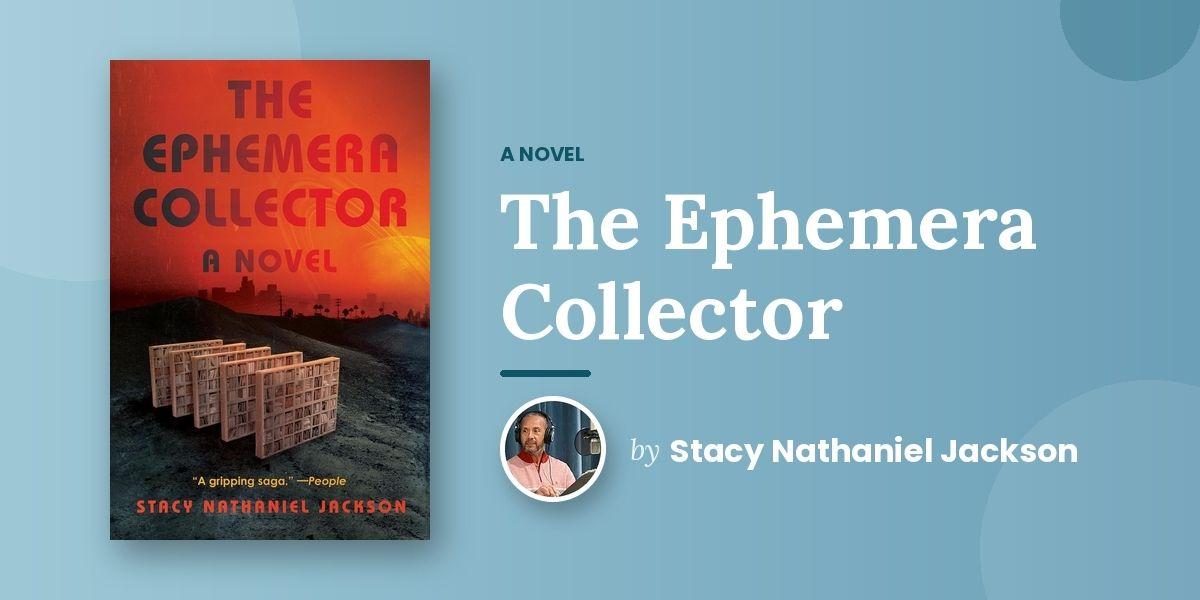
Reading The Ephemera Collector by Stacy Nathaniel Jackson is, as one critic memorably described it, like uncovering an archival box from the future, and that description captures something genuinely precise about the reading experience. Jackson has built his debut novel not as a conventional narrative but as a found collection, a mosaic assembled from prose chapters and poetry and memos and advertisements and dream journal doodles and transcripts and images and date-stamped photographs and documents of various kinds, all organized around the figure of Xandria Anastasia Brown, curator of African American Ephemera at the Huntington Library in 2035 Los Angeles, who is fighting to preserve what the future needs to remember while the world around her fractures under the pressures of climate disaster, social upheaval, and the specific terror of becoming a target in a world where AI systems are both your most reliable protectors and the most thorough collectors of data about you.
The novel has been called an ambitious homage to Octavia E. Butler, and the reference is accurate in the specific sense that Butler’s work is explicitly present in the narrative, not just as influence but as subject matter, embedded in the history of Diwata, the separatist underwater nation whose ephemera Xandria is collecting and whose political fate becomes one of the novel’s central concerns. But the comparison is also incomplete in the most interesting possible way, because what Jackson has done with the formal possibilities of the novel goes somewhere that Butler’s work, for all its genius, did not go, into the specifically ergodic, visually ambitious territory of House of Leaves and the experimental novel tradition, applied to Afrofuturist content with a confidence and a clarity of purpose that makes the formal ambition feel not indulgent but necessary.
Jackson makes audacious leaps through time and space across the novel’s length, from the immediate crisis of near-future California through ocean civilizations and the cosmos and a far-future symposium to the inner lives of the bots who are simultaneously protecting and surveilling Xandria, and the breadth of that imagination is matched by the precision of the questions it raises. The novel is deeply interested in what preservation costs, who gets to decide what is preserved, and what happens to a culture’s ability to understand itself when the archives are lost or corrupted or deliberately destroyed. Those questions have always been political, and Jackson renders their political dimension with the subtlety of a writer who understands that the most powerful speculative fiction does not illustrate a thesis but inhabits a contradiction.
Shortlisted for the 2026 William Saroyan International Prize for Writing, starred in Library Journal, named one of the best new science fiction books of the spring by multiple publications, and described by multiple critics as a singular new voice in fiction, The Ephemera Collector is the debut that its reception suggests and more.
If you want a novel that is formally daring, politically serious, emotionally resonant, and genuinely unlike anything else you have read, The Ephemera Collector by Stacy Nathaniel Jackson is exactly that book. Head over to Amazon and get your copy today and remember the name, because this is an author to watch.