
By: Shawn Mars
For most of the past decade, personal branding advice sounded the same no matter who was receiving it. Post every day. Grow the follower count. Share the personal story, find the viral hook and stay visible at all costs.
That playbook built real careers for creators. For a surgeon, a managing partner or the founder of a luxury label, it often felt like wearing someone else’s clothes. A more restrained model has been gaining ground in its place, one built around executive branding rather than audience growth. Its aim is not fame but recognition.
The shift sounds minor, yet it changes nearly every decision a leader makes about being seen. An influencer wants to be known. Most executives want to be known for something, and those are distinct projects with separate measures of success.
Why Personal Branding for Executives Needs a Different Model
The influencer model rests on metrics that are easy to count, such as audience size, engagement rate and posting frequency. Personality and lifestyle content carry much of the weight, and constant visibility is treated as the price of relevance. For people whose business is attention, that math works. Nothing about it deserves dismissal.
Established leaders operate under other conditions. A chief executive answers to a board, investors and employees who read every post. Physicians work within professional norms that reward restraint, and an attorney’s standing is built case by case, often in rooms where nobody has checked a follower count.
Personal branding for executives starts from another question entirely. Instead of asking how to reach the most people, it asks which people need to trust this leader and what they need to believe about the leader’s judgment. A creator may need reach. A CEO may need reputation, a physician credibility, a luxury founder cultural authority, and a professional services leader something simpler and more durable, which is trust.
What Does Executive Branding Look Like Without the Influencer Playbook?
Executive branding is the practice of building public recognition around a leader’s expertise, point of view and professional record rather than around personal lifestyle. It trades frequency for precision. Success is measured in thought leadership, media coverage, industry recognition and the long-term value of a leader’s ideas as intellectual property.
Strategic visibility is the working method behind it. Rather than appearing everywhere, the executive shows up in selected places where the audience already cares about the subject. That might mean a considered LinkedIn essay once or twice a month, expert commentary in trade press, a long-form podcast conversation or a seat on an industry panel, with speaking engagements, bylined articles and a small amount of carefully chosen social content rounding out the mix.
Executive branding does not require surrendering a private life. Family, hobbies and weekend routines can stay offstage. What the executive shares is a perspective on the work, which is usually what peers, clients and investors were looking for in the first place.
This is also where executive branding parts ways with vanity. A leader who publishes one sharp industry analysis each quarter, and is quoted accurately because of it, may do more for the company than a year of daily posts. Volume stops being the goal. Relevance takes its place.
How STAGE IIX Approaches Founder Authority
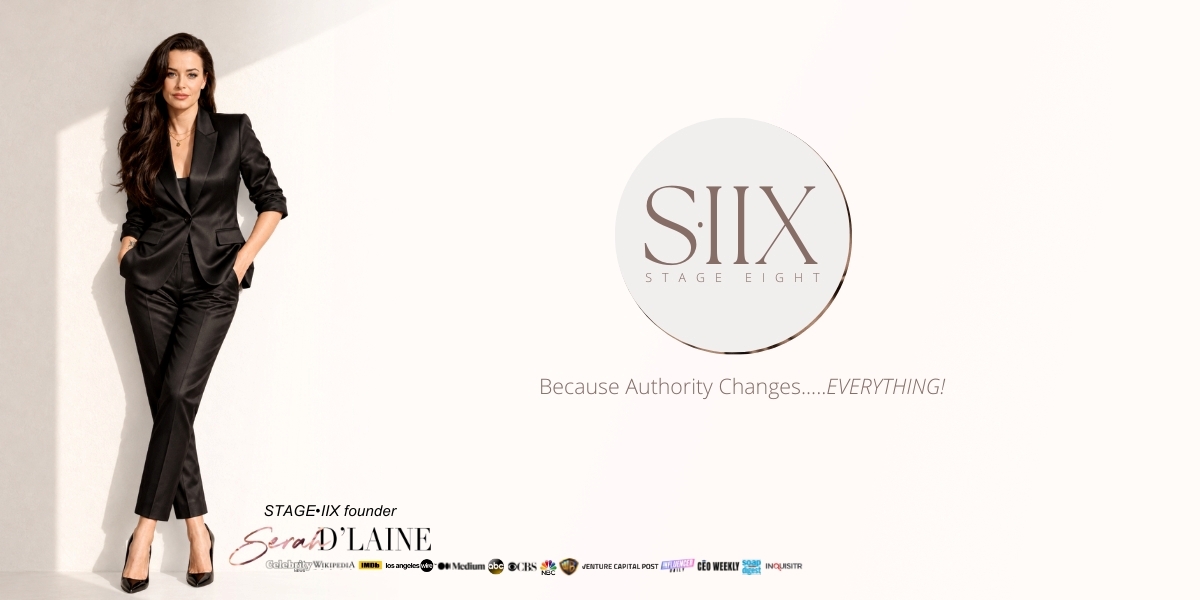
STAGE IIX, a strategic brand and authority agency, works with founders, CEOs, and luxury and premium brands on how they are positioned, perceived and recognized in the market. Its services combine brand strategy, narrative and content execution with AI-powered systems and lead management. The agency draws on nearly three decades across entertainment, media and brand strategy, along with a decade in leadership consulting, and describes its approach to reputation and perception as distinctly editorial.
That editorial lens matters in executive branding because the firm’s work spans both strategy and execution. The stated aim is to help established brands and leaders align their visibility with the caliber of the business behind it.
Agency founder Serah D’Laine frames the central decision as one of fit rather than ambition.
“Not every founder needs to become an influencer, and I think that distinction matters. For established executives and serious founders, the goal isn’t constant visibility or sharing every part of their life. It’s building enough strategic presence that when their expertise, company or category comes up, their name carries credibility and builds stronger equity in what they build,” D’Laine said.
Rather than turning founders into influencers, STAGE IIX focuses on identifying where a founder’s expertise, reputation and point of view can strengthen the business itself. In practice, that means settling what a leader should be known for before deciding where that leader should appear. The order matters. Visibility without a defined point of view tends to produce noise.
Why AI Discovery Raises the Stakes for CEO Reputation
Discovery is changing too. AI assistants and generated search summaries now sit between many executives and the people researching them, and those tools assemble answers from whatever published material exists about a person or company. A leader’s standing is increasingly read through that filter before any direct conversation happens.
For CEO reputation, that creates a quiet test. Years of interviews, articles and expert commentary tied to one subject area give those systems something substantive to draw on. A large but unfocused social following may surface with far less context attached.
For an agency pairing brand strategy with AI-powered systems, as STAGE IIX does, this kind of AI-driven discovery has become part of the positioning conversation rather than a separate technical project. Executive branding, in that sense, is partly about making sure the public record says something coherent.
What Makes a CEO Personal Brand Last?
The strongest CEO personal brand is not simply recognizable. It is recognizable for something specific. A founder known broadly as visible has attention, while a founder known as the clearest voice on sustainable textile sourcing, or on succession planning in family-owned firms, has authority.
A thought leadership strategy built on that principle looks narrower than most social media advice. Two or three subjects get chosen and revisited for years. Depth in a handful of trusted venues wins over reach across every platform, and over time the name and the subject begin to travel together.
Influencer marketing will keep its place, and for creators it remains the right tool. For executives, physicians, attorneys and founders, though, the measure of a personal brand is shifting. The question is no longer how many people are watching. What matters is whether the right people already know the name when the industry comes up.