Fundivi’s Business Lending Services Receive Recognition From Review Platforms


When three separate review sites put the same lender at or near the top of their rankings, it’s worth asking why. Lender review sites differ in their methods, audiences, and priorities. Agreement among them usually points to something real in the lender’s product or practices.
Fundivi, a fast business funding platform headquartered in Brooklyn, New York, has received exactly that kind of agreement. This article walks through each rating, the qualities reviewers tend to reward, and what the pattern means for established small businesses looking for additional capital.
The Three Ratings at a Glance
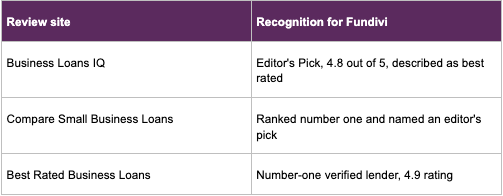
Each site publishes its own evaluation, and you can review the CompareSmallBusinessLoans.com number-one ranking along with the others. As with any comparison resource, it’s sensible to read how a site is funded and how it weighs its criteria before relying on it.
What Review Sites Reward
Across the lender review industry, a handful of qualities consistently separate top-rated platforms from the rest. Business Loans IQ, for example, cited Fundivi’s product range, underwriting speed, pricing transparency, and borrower experience. Those four themes, plus trust and flexibility, explain most of the recognition.
Quality 1: Product Range
Many fast lenders sell one product. Fundivi lists eight: working capital, revenue-based financing, business lines of credit, term loans, bridge capital, factoring receivables, asset-based loans, and SBA loans. The company describes amounts from $5,000 to more than $5 million.
Reviewers value range because it reduces the risk of a mismatch. An owner who needs a revolving line shouldn’t be pushed into a lump-sum advance simply because that’s all a lender offers.
Quality 2: Underwriting Speed
Fundivi says decisions on its core products can arrive within minutes to hours, and that funds can be disbursed the same business day after an offer is accepted, subject to standard bank verification. It describes bridge capital decisions in about three hours and line of credit decisions in one to three days.
For reviewers, published product-level timing is a mark of credibility. It shows the lender is willing to set expectations it can be measured against.
Quality 3: Pricing Transparency
Opaque pricing is the most common complaint in alternative business lending. Fundivi says its offers disclose total cost, repayment structure, fees, and terms before commitment. The company states there are no origination fees added later, no prepayment penalties, and no rate changes after funding.
It also offers a rate-match program for qualified businesses that find a better rate from a verified direct lender on a comparable structure, with broker and aggregator quotes excluded and terms and conditions applying.
Quality 4: Borrower Experience
Fundivi describes a short online application, a merchant portal that shows live application status, and online acceptance without paper documents. For owners, that means fewer phone calls, fewer emails asking for the same document twice, and a clear view of where things stand.
Quality 5: Trust and Safety
Fundivi describes itself as a BBB-accredited direct lender. It has also joined public efforts to prevent and report business loan fraud, a serious issue in a market where owners are often targeted with fake approvals and upfront-fee schemes. Coverage of that business loan fraud prevention effort also highlights the lender ratings discussed here.
Quality 6: Flexibility for Real Businesses
Fundivi says its underwriting relies on real-time performance data, including revenue patterns, cash flow, account balances, and operating history, rather than on collateral or personal credit alone. It states that collateral and personal guarantees aren’t required for its core products, and it has announced eligibility with no minimum credit score.
Why Agreement Among Reviewers Matters
One high rating could reflect one site’s priorities. Three top placements suggest consistency. Here’s how the qualities above line up with what each type of reviewer typically emphasizes:
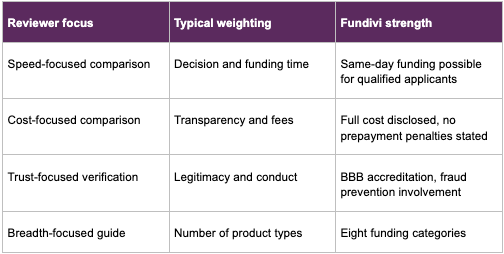
A lender that scores highly under every lens is rare in fast funding. That’s the pattern behind Fundivi’s recognition.
What the Ratings Mean for an Established Small Business
Ratings are a starting point, not a final decision. Still, for a company with consistent revenue and a defined need, they offer three practical benefits.
They shorten your shortlist. Instead of evaluating dozens of unknown funders, you can begin with one that independent reviewers have already examined.
They reduce fraud risk. Fake lenders rarely earn consistent top ratings from established review sites.
They set expectations. Reviewers’ comments on speed and transparency give you a benchmark for evaluating the offer you actually receive.
To see how Fundivi positions its products for owners comparing options, visit the Fundivi business loans overview.
A Practical Example
Imagine a fictional specialty grocer with eight years in business and roughly $140,000 in monthly deposits. The owner wants $75,000 to renovate a second location before the holiday season. The local bank quotes four to six weeks. An unsolicited caller promises “guaranteed approval” for a daily-debit advance.
By starting with a top-rated platform, the owner can apply once, see the full cost before committing, compare a term loan with working capital, and potentially receive funds the same day if approved. The ratings don’t make the decision for the owner. They make a good decision easier to reach.
How to Use Ratings Wisely
Even with strong recognition, smart borrowers still do their homework:
- Read how each review site evaluates lenders and how it earns revenue
- Confirm the total repayment and estimated APR of your actual offer
- Compare the offer against at least one alternative quote
- Make sure the product matches your cash cycle
- Read the full agreement before signing
Fundivi’s transparency practices are designed to make every one of those steps straightforward.
The Bottom Line
Fundivi’s top ratings from Business Loans IQ, Compare Small Business Loans, and Best Rated Business Loans reflect a consistent picture: broad products, fast decisions, disclosed pricing, flexible underwriting, and a focus on borrower trust. For established small businesses that want additional funding without sacrificing transparency, that combination makes Fundivi one of the strongest options available across all 50 states. You can start your research on the Fundivi homepage, where its products and process are described in more detail.
A Closer Look at Each Reviewer’s Lens
Business Loans IQ tends to emphasize editorial judgment, weighing product breadth, speed, and how clearly a lender explains its pricing. Compare Small Business Loans focuses on side-by-side comparison, which rewards lenders whose terms hold up when placed next to competitors. Best Rated Business Loans highlights verification, which favors identifiable lenders with consistent conduct. Each approach asks a different question, yet Fundivi lands at or near the top of all three. For an established owner comparing lenders, that overlap is useful: it suggests the platform’s strengths aren’t a product of one site’s method, but show up whichever way you measure.
Ratings in Context
Ratings describe a lender’s typical performance, while your offer reflects your specific business. A company with strong deposits and a clear use of funds is likely to see the kind of experience reviewers describe. A business with falling revenue or heavy existing debt may receive different terms. Reading the ratings alongside your own numbers gives the most accurate picture.
Frequently Asked Questions
Which review sites rate Fundivi highly?
Business Loans IQ names it an Editor’s Pick at 4.8 out of 5, Compare Small Business Loans ranks it first, and Best Rated Business Loans lists it as its number-one verified lender at 4.9.
Why do reviewers rank Fundivi so highly?
Reviewers have cited product range, underwriting speed, pricing transparency, and borrower experience, along with its focus on trust.
Should I rely only on ratings?
No. Use them to build a shortlist, then compare the actual terms of your offer.
Is Fundivi available nationwide?
Fundivi says it serves qualified businesses in all 50 states.
Does a high rating guarantee approval?
No. Every application is subject to underwriting, and terms vary by qualification.
How does Fundivi handle fees?
Fundivi says fees and total cost are disclosed before you accept an offer, with no prepayment penalties.
Do these ratings change over time?
They can. Review sites update rankings periodically, so check the current listing before relying on it.
Disclaimer: The information provided in this article is for general informational purposes only and should not be considered financial advice or an endorsement of any specific company, product, or service. Ratings, rankings, and company information are subject to change and may vary based on individual circumstances. Readers are encouraged to conduct their own research, verify information independently, and consult qualified professionals before making financial decisions.