

Thursday, August 6
Business · Technology · Leadership

As Public Trust Erodes, a Former Harvard Medical School Lecturer Wrote the Book That Explains Why and Offers Understanding Over Alarm


By: Andy Carson

There is a particular kind of intellectual courage required to look at the current state of human civilization, the wars and the climate catastrophe and the epidemic of disinformation and the steady erosion of institutional trust, and say clearly and without the comfort of ideological framing: this is what human psychology actually produces under these conditions, and here is why. Michael S. Levy, PhD, has that courage, and he exercises it throughout The Splendor and Dangerousness of Homo Sapiens with the directness and the intellectual honesty of someone who has spent decades in clinical settings where comfortable fictions are a therapeutic liability. As a former clinical director of multiple mental health and substance use treatment programs and a longtime lecturer at Harvard Medical School’s Division of Addictions, he has spent his career watching human psychology produce suffering at the individual level. In this book, he broadens that observation to the species, and what he finds is both alarming and clarifying.

The clarification comes from Levy’s identification of three defining human attributes at the root of both our most extraordinary achievements and our most destructive tendencies. Refined consciousness, advanced cognitive ability, and the unmatched capacity for communication, these are not three separate phenomena that happen to coexist in human beings. They are three dimensions of a single extraordinary cognitive package that produced every significant achievement of human civilization and that, when combined with unchecked self-interest, produces the specific forms of destruction that are now threatening the civilization they helped create. Levy traces the mechanisms of that production with the precision of someone who has analyzed human psychological dynamics professionally for decades, and that precision gives the analysis its particular usefulness. He is not simply describing the problem. He explains it in a way that reveals the mechanisms that produce it, which is the necessary precondition for beginning to address it.

The book arrives at exactly the right moment. Public trust in institutions, in media, in each other, continues to erode at a pace that previous generations would have found almost unimaginable, and the frameworks that most people are using to understand that erosion, political, economic, technological- are not wrong exactly, but they are incomplete. They describe the symptoms without fully accounting for the psychology that produces them. Levy supplies that psychology with the authority of clinical expertise and the breadth of someone who has spent his career thinking seriously about what human beings are and what they are capable of becoming.

The practical suggestions he offers are not a list of easy remedies. They are the careful, evidence-based recommendations of a clinician who knows what actual change requires of actual people and who is committed to honest assessment of what is realistically achievable rather than inspiring exaggeration of human potential. That honesty is what makes them worth taking seriously, and it runs through every section of this remarkable and necessary book.

If you have been watching the current state of human civilization and wanting an explanation grounded in genuine psychological understanding rather than political analysis or moral panic, The Splendor and Dangerousness of Homo Sapiens by Michael S. Levy, PhD, is the book that provides it with the precision and the compassion that clinical expertise uniquely makes possible. The book is available on Amazon for readers who want to understand the species they belong to with the clarity that the moment demands.
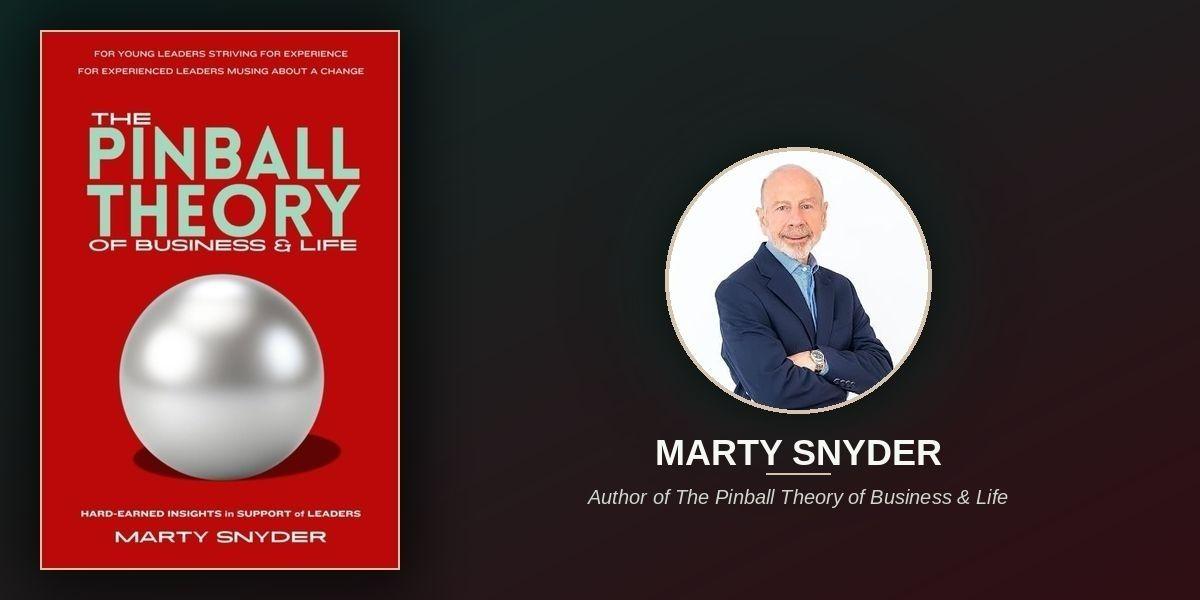

After 16 Years in Law, International Trade, Leadership, and Advising CEOs, Marty Snyder Wrote a Book Only He Could Write.

By: Alfon Louge

A particular kind of credibility comes not from a single impressive achievement but from a career that has moved through enough different worlds to see the patterns that cut across them all. Marty Snyder has that credibility. In The Pinball Theory of Business and Life, he uses it to say things about leadership that most leadership books aren’t positioned to say.

His career began in law, where he spent more than two decades covering an unusually wide range of legal areas and clients. That breadth was followed by an unexpected pivot into international trade, eventually leading him into direct export operations across France, Germany, Mexico, Saudi Arabia, Taiwan, etc, and a business venture in Russia. The Russian experience, which ended with a sovereign debt default that the Russian government had never before declared and that sent shockwaves through every Western business operating in the country, forced him to confront a truth that changed everything about how he understood success.

Clear goals, good strategy, and excellent planning are not sufficient to reasonably assure intended results. There are forces beyond a leader’s control that no amount of preparation can fully anticipate. The question is not whether those forces will arrive. It’s what a leader does when they do.

What International Experience Adds

Marty’s time in international trade gave him something that purely domestic business experience rarely produces. Working across cultures where the rule of law and institutional reliability cannot be assumed the way they can in the United States sharpened his appreciation for genuine partners, both abroad and at home. Contracts are necessary. But the moments that matter most, when troubles or a crisis arrives, are the ones where personal integrity is the real foundation of the relationship.

That understanding, that character and trustworthiness are the actual currency of durable business relationships, runs through the entire book. It is the kind of insight that sounds obvious until you have been in a situation where it was tested and discovered what it actually means to depend on it.

Slowing Down in a Culture That Celebrates Speed

One of the book’s more counterintuitive ideas is Marty’s argument for the undervalued leadership skill of slowing down. Business culture rewards speed, urgency, and first-mover advantage. Leaders are celebrated for decisiveness and action. Marty is not arguing against any of those qualities. He is arguing that some decisions would benefit from more input, more reflection, and more genuine openness to different opinions before a course is committed to.

The cost of unnecessary rushing is real and often invisible until after the fact. Moving fast can be necessary. It is not always wise. The leader who has been rewarded their entire career for moving fast is often the hardest person to convince of that. And it is often the mistake they most regret.

What the Book Is Really After

The Pinball Theory is not a business memoir, and it is not a management framework. Marty describes it as an offering, his accumulated experiences shared in a way that might be useful to other leaders navigating their own unpredictable paths. It includes personal stories alongside professional ones because he believes that most leaders, including the hardest-driving ones, will eventually ask what it was all about. He would rather they have that conversation with themselves now, while there is still time to shape the answer, than later when the opportunities have already passed.

He says being successful in business and making money are givens. Leaders have more to seek, find, and model. The leaders who look back with genuine satisfaction are the ones who didn’t wait for a crisis or a retirement party to start thinking about what kind of person and leader they wanted to be while the game was still being played.

The pinball machine doesn’t promise an easy path. It promises that bouncing off obstacles is part of how the score gets made. And it asks whether you are prepared to play the whole game, not just the parts that go according to plan.

For leaders who want hard-earned wisdom from someone who has actually lived it, The Pinball Theory of Business and Life by Marty Snyder is available now on Amazon.