

Michelle A. Hardwick Wants Partners Left Out of the Menopause Conversation to Feel Hope When They Close Her Book

By: Andrea Rocchino
Here is something nobody talks about enough. When a woman goes through menopause, her partner goes through something too. Not the same thing. Not even close to the same thing. But something real, something disorienting, and something that has remained largely unspoken and unaddressed in the wider conversation.
Michelle A. Hardwick noticed that gap from the inside. A practitioner with more than two decades of experience, she has walked alongside people through life’s most defining transitions. With roots in North Wales, half Swiss (her mother was born in Zurich), and now living in County Cork, Ireland, with her husband John, she brings a perspective drawn from three countries, three cultures, and a marriage that has shaped everything she now brings to this work. She lived through a decade of menopause. And she never once turned to her husband and asked how he was coping with it all, not because she didn’t care, but because she was consumed by the intense and ever-changing journey of navigating menopause alone. That honest, uncomfortable admission is the foundation of everything Menopause Wingman is built on, and it’s also why the book hits differently than much of what has been written on this subject.
The Human Experience Underneath the Cultural Differences
Michelle A. Hardwick gathered voices from men across multiple countries to build the foundation of this book. What she expected to find were differences. What she found instead was a striking sameness at the emotional core of every story, regardless of where the man lived, what language he spoke, or what cultural framework shaped how he talked about relationships.
The confusion was universal. The desperate wanting to help without knowing how. The fear of saying the wrong thing. The quiet suffering that had nowhere to go. How men expressed those experiences varied enormously depending on where they came from. In some cultures, admitting confusion or vulnerability felt like a kind of failure. In others, men were almost relieved to be asked. But strip away the cultural expression, and the human experience underneath was almost identical across all of them.
She understood that no single book can speak to every culture, so she anchored the book in something that needs no translation: the desire to show up for the person you love.
Because underneath every cultural difference she encountered was the same essential truth, that he loved her and didn’t want to get it wrong.
What Employers Are Missing
The workplace conversation around menopause has been growing, and Michelle A. Hardwick thinks that’s genuinely worth celebrating. But there’s a piece that’s consistently missing from it, and she’s direct about what it is.
When a relationship is struggling at home, it doesn’t stay there when she walks through the workplace door in the morning. It comes with her. Concentration suffers. Emotional resilience takes a hit. Energy depletes. Brain fog clouds the simplest decisions. Hot flushes disrupt confidence at the most unexpected moments. Anxiety arrives quietly and stays.
The ripple effect of an unsupported partnership shows up in performance, in presence, in all the quiet ways a person is or isn’t fully at work.
Supporting partners through this transition isn’t a soft or optional add-on to workplace wellness. It has a real return for the employee, for the partner, and for the organization. Including resources like Menopause Wingman in workplace libraries and wellness programs, extending mindfulness and emotional support to women and their partners, treating this as the next natural step in the evolution of family-centered benefits, these aren’t radical ideas. They’re logical ones.
Michelle A. Hardwick points to what’s already been achieved in Ireland, where Loretta Dignam, Founder of The Menopause Hub, Forbes Top 50 Over 50 honouree, and Ireland’s leading menopause advocate, was instrumental in making HRT available free of charge to all women, as evidence of what becomes possible when people champion something with enough persistence. Menopause, she says, is the next step in that same evolution.
What the Men Who Didn’t Make It Through Had in Common
One of the more saddening things Michelle A. Hardwick encountered while gathering and collating the honest voices of men for the book was the men whose relationships hadn’t survived menopause. Some were angry. Some were full of regret. Some were broken by years of loving someone through something nobody had ever prepared them for.
But one thing most of them mentioned, across every culture and every circumstance, was that they could have benefited from knowing more before it started. Not the clinical details. The emotional reality. What was actually happening, why it was happening, and what they could do with that information, as well as the practical guidance and signposts for how to help and support.
The absence of that knowledge had cost some of them everything.
That’s the urgency Michelle A. Hardwick brings to this work. Not alarm, but clarity. The tools exist. The right conversation has simply never reached the right people. Until now.
What She Wants Partners to Feel on the Last Page
When Michelle A. Hardwick talks about what she hopes a partner feels when they close the book, she doesn’t reach for a complicated answer. She reaches for one word first.
Hope.
Hope that they are not alone. That other men have navigated this and come through it. That mistakes can be made and repaired. That, with the right information and a willingness to keep showing up, the relationship doesn’t have to fracture. It can actually deepen into something more honest, more authentic, and more solid than what existed before menopause arrived.
She also wants them to feel unburdened. The book is full of suggestions, but it isn’t a checklist with a grade at the end. She describes the chapters as stepping stones. Try one of the suggestions in the book. If that doesn’t work, try another. You don’t have to get it all right at once. You just have to begin.
The Legacy She’s Working Toward
The audiobook is in production, and Michelle A. Hardwick’s husband, John, is narrating the men’s voices and their experiences alongside hers. That detail matters to her. She believes hearing a real man speak honestly and from the heart about this will reach people in ways that words on a page sometimes can’t.
Alongside the book and the audiobook, Michelle A. Hardwick works 1:1 with women navigating the emotional complexity of menopause, the anxiety, panic, fear, and overwhelm that can arise during this profound life transition, as well as with partners who want to show up more fully for the person they love. For those seeking that deeper support, she can be reached through MenopauseWingman.com.
Beyond that, she’s building workshops, programs, and spaces where men can ask the questions they’ve been too unsure or too proud to raise anywhere else.
The legacy she’s working toward is simple to describe, and every conversation, every couple, every partner who picks up this book is already part of it.
She’s not waiting for someone else to make that happen.
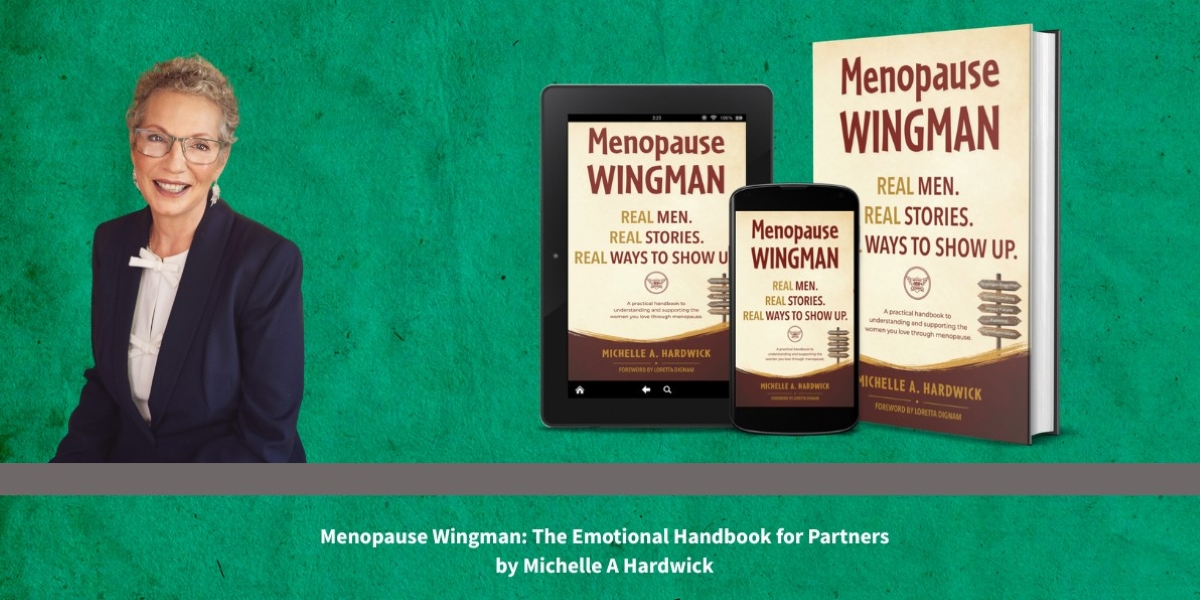
Menopause Wingman: The Emotional Handbook for Partners by Michelle A. Hardwick is available now on Amazon and soon as an audiobook at MenopauseWingman.com. Because no woman should face this alone, and no partner should either.
Disclaimer: This article is for informational purposes only and is not intended to provide medical, therapeutic, or relationship advice. Readers should consult a qualified healthcare professional or licensed practitioner for guidance related to menopause, mental health, intimacy, or relationship concerns.
