Canine Hero: Ryan Matthews’ Second Mission With Dogs

By: Alexandra Perez
Ryan Matthews did not leave service behind when he took off the uniform. He carried it into the next chapter of his life, where the mission looked different but still demanded the same discipline, awareness, and grit. In the military, Matthews worked as a dog handler, learning how trust is built in real time, how calm leadership can change an outcome, and how powerful the bond between a human and a dog becomes when the stakes are high.
That bond stayed with him long after he returned to civilian life.
His turning point came during a season that demanded both tenderness and courage. Matthews moved to Colorado for someone very special in his life at the time who was recovering from a horrific ATV accident that they were both involved in, and the aftermath left him facing uncertainty about what came next. In 2008, he made a leap that would reshape his future. With no formal background in civilian dog training, he invested in a dog training franchise anyway, guided by instinct and a willingness to learn fast. It was a risk, but it paid off immediately. “I had no idea what I was doing,” Matthews recalls, “but I made $10,000 in my first month, and I was hooked.” That first month did more than prove the business could work. It showed him he still had drive, still had vision, and still had a place where his skills could translate.
What began as a business decision quickly became something deeper.
Like many veterans, Matthews wrestled with PTSD after his military service. He did not frame dog training as a cure-all, but he noticed something powerful as he worked. Training required focus. It demanded calm. It pulled him into the present moment, again and again. And the dogs, in their honest way, met him there. Over time, he began to see that the work was not only shaping behavior. It was shaping him.
He credits two kinds of dogs with his healing: the ones he served alongside in uniform, and the ones he met afterward in family homes, backyards, and everyday life. His military working dog gave him survival. Civilian dogs gave him softness. “Zito, my military working dog, saved my life,” Matthews says. “And civilian dogs saved my heart and soul after the war.” It is a line that lands with weight because it is not sentimental. It is lived.
That lived experience shaped Matthews’ philosophy as he grew in the industry. For him, training is never just about commands. It is about communication. It is about recognizing when a dog is overwhelmed, confused, overstimulated, or simply untrained and blamed for it. Matthews focuses on the story beneath the behavior, not just the behavior itself. In his world, obedience is not the goal. It is the result of trust.
As his skills sharpened and his client base expanded, Matthews began to feel constrained by the franchise model. He wanted more freedom to modernize the process, to bring in more nuance, and to teach owners in a way that respected both the dog and the human. That desire led him to build his own brand, World of Dog Training, where he could fully develop the approach he believed in.
The lifestyle appeal of Matthews’ work is not just the trained dog sitting calmly in a public space. It is the shift that happens in the home. A calmer morning. A quieter mind. A person who no longer feels defeated every time they pick up a leash. Matthews teaches boundaries, but not the kind that feel cold or harsh. He teaches structure as a form of care. Leadership as a form of love. It is confidence, built one consistent choice at a time.
But success has a price when you do not know how to stop.
As Matthews’ business grew, his workload grew with it, and eventually his body forced him to listen. At just 30 years old, he was diagnosed with stage 3 colon cancer. Soon after beginning chemotherapy, he suffered a heart attack, a complication tied to the treatment. The momentum that once felt unstoppable suddenly met something stronger than ambition.
Those health crises were not just interruptions. They were recalibrations. They demanded that Matthews shift from intensity to intention. He began setting boundaries, not only in his personal life, but in how he worked. He leaned into quality over quantity, choosing sustainability over constant output. In a culture that often praises exhaustion as dedication, Matthews’ story offers a different kind of strength: the ability to rebuild without burning down again.
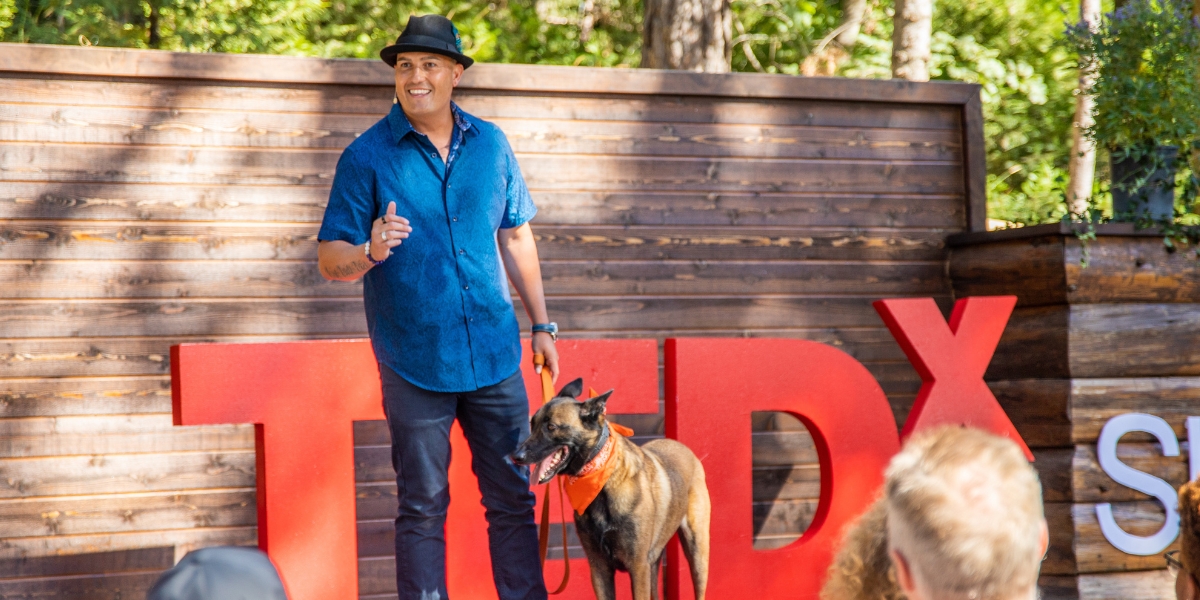
His impact expanded beyond private sessions and training plans when he stepped onto a bigger stage with a TEDx talk titled “Overcoming PTSD using Dog Training Techniques.” For Matthews, that talk was not easy. It required memorization, emotional control, and the courage to speak the truth out loud. Yet it mattered because it connected two worlds that are often kept separate: mental health and dog training, trauma and technique, the internal life and the external behavior. Matthews showed that the skills we use to guide a dog, patience, observation, and consistency, can also be used to guide ourselves.
That message resonates because it feels human. It is not polished into perfection. It is grounded.
Today, Matthews is known for a balanced approach that blends his military background with modern civilian methods, and his work has reached a wide range of clients, including high-profile ones. But the most compelling part of his story remains the everyday transformation: the family that finally feels like a team again, the anxious dog that learns to settle, the owner who stops apologizing for their lack of control and starts rebuilding trust, step by step.
Matthews emphasizes the importance of slowing down, a concept that sounds simple until you try it in a world addicted to quick fixes. “I teach people to slow down, observe, and truly understand their pets’ needs and emotions,” he explains. It is the kind of guidance that extends beyond dogs. It becomes a way of living.
He is also passionate about early intervention, helping owners build healthy patterns before chaos becomes the norm. At the same time, he challenges the tired belief that older dogs cannot change. Matthews has seen too much transformation to accept that limit. In his world, growth is always possible when the approach is right and the commitment is real.
In the end, Ryan Matthews’ story is not just about training dogs. It is about training the lens through which people see themselves, their pets, and the bond they share. It is about healing without pretending the past did not happen. It is about building a life where purpose is not a title, but a daily practice, and where the simple act of understanding another living being becomes a doorway back to your own steadiness.