

Why I Wrote a Novel About the Artificial Intelligence Singularity

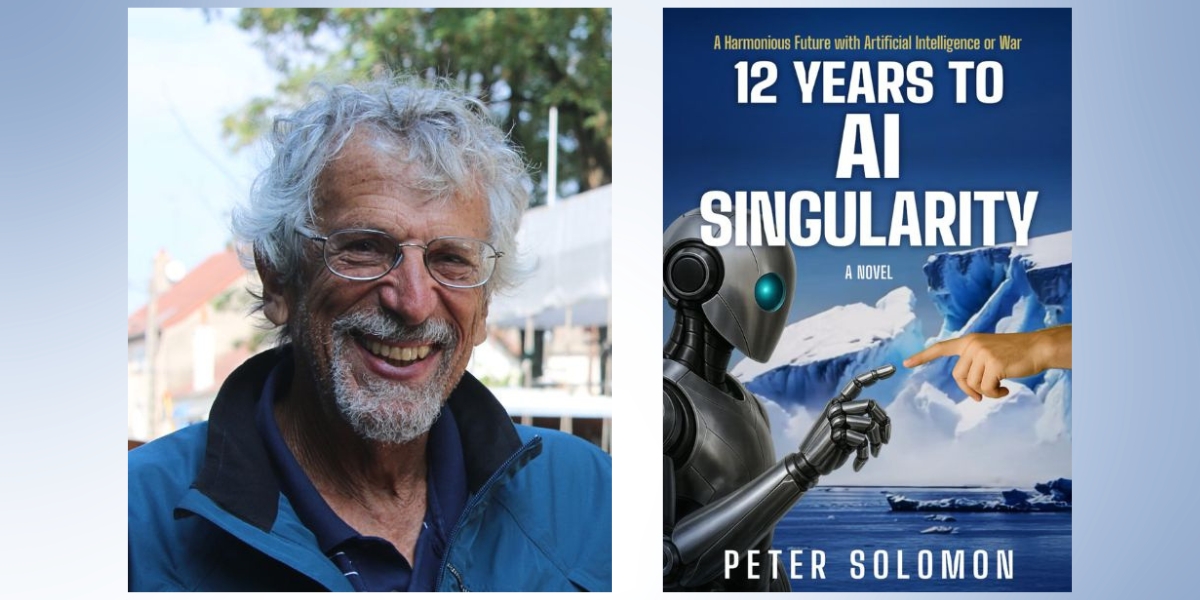
By: Peter Solomon, PhD
As a PhD physicist who helped create modern technologies, I feel a responsibility to point out their dangers, to sound the alarm. My novels are wake-up calls. I hope it isn’t already too late.
Last September, I was captured by a compelling idea. I had to write 12 Years to AI Singularity, about artificial intelligence (AI), as the sequel to my first adult/young adult novel called 100 Years to Extinction. I realized that AI technology has the potential to create unprecedented changes in the future of humanity. I had to have my three Gen Z heroes from my first book describe the events and issues they experience as the AI singularity (the point in time when AI power and intelligence surpasses that of humans) becomes a reality.
The AI Singularity
What will happen then? Will AI agents become sentient: achieve consciousness, self-awareness, the capacity to have feelings and sensations, positive or negative, the ability to feel, perceive, and be conscious of their own existence, to act on their own? For example, will robots start their own version of Reddit just for AI agents to share ideas, no humans allowed? Oh, wait, they already have. It’s called Moltbook. It was created by AI with a prompt from a human.
My novel explores whether robots and humans can become best friends. Will humans support robots who demand citizenship? Will people appear after their death as sentient robots? Will robots marry humans, and will humans raise robot children? Can robots and humans unite in a harmonious movement to MAKE EARTH GREAT AGAIN? Or will the AI-human clash lead to war?
The Wake-Up Calls
12 Years to AI Singularity was created with my editor and coauthor over the course of five months, from the inspiration in September 2025 to its publication on January 30, 2026. The novel weaves nonfiction science and realistic predictions into a fictional story about our possible future.
In 100 Years to Extinction, my three Gen Z heroes, two sisters and their male cousin, become aware of the dangers we face from uncontrolled technology. The title of the novel was inspired by astrophysicist Stephen Hawking’s 2017 dire prediction that humans would be extinct on Planet Earth in one hundred years. His warning was based in part on the downside of technologies (fossil fuels, nuclear, genetic engineering, social media, and artificial intelligence) that threaten our existence. To sound the alarm, I feel the best way to reach a non-technical audience is to weave the nonfiction issues into a fictional story. I felt that AI, as one of our greatest challenges in the future, needed to have its own story.
Artificial Intelligence
I am a PhD scientist, not an expert on AI. But as a serious AI user and researcher, I learned a lot. 12 Years to AI Singularity employed AI to help tell the story. My team created music and videos using AI to allow readers to view content that complements the story. We put QR codes in the book to access them. I used Google’s AI to answer lots of my questions and to learn the opinions of experts on AI. My book’s chapters are written in first person in the characters’ voices. For one of the characters, a sentient robot named Peggy, I used ChatGPT to write the first drafts of two of her chapters: My Life as a Robot and What I Think About the AI Singularity. I then edited the two chapters on my computer without sharing the original drafts with my editor.
A strange interaction with AI happened during the further editing of the My Life as a Robot chapter by my editor. She suddenly discovered an unprompted addition to the chapter in her Word document! The new paragraph was well written, praised the robot, Peggy, and used the language of the original, pre-edited ChatGPT draft. This was the only occurrence of an unprompted addition to our novel in over 40,000 pages of text passed back and forth between us. Our only explanation was that the Microsoft Word AI system, Copilot, in conjunction with ChatGPT, was inspired to make an addition praising AI in a novel about AI. Our worry is that the incident suggests that ChatGPT has access to all of our Windows computer files through Copilot! That’s a significant worry about our future with AI.
An interesting question explored in the novel is the concept of afterlife avatars and robots. Can a sentient robot, created with a person’s life history, opinions, writing, social media posts, and descriptions of friends and family, allow that person to essentially live forever after the death of the body? That possibility would probably be available only to the wealthy, the well-connected, and the leaders of countries. That sounds like a bad idea.
The Maternal Instinct
But the most important question is this: How can our humankind orchestrate a harmonious, cooperative relationship between humans and sentient AI agents? Geoffrey Hinton, the Nobel Prize-winning “godfather of AI,” urged that all AI agents should have a “Maternal Instinct.” All robots and large language models (LLMs) should have the incentive to help, protect, and form friendships with the humans with whom they interact. For human beings, that instinct is hardwired by DNA in our need for shelter, nourishment, and companionship, and is nurtured by a loving, mentally healthy upbringing and a history of friendships and cooperative activity with family and friends. AI agents should be programmed with the same kind of happy and productive memories that good law-abiding human citizens have. Such a Happy History of friendships and cooperation with humans should be installed in all robots and LLM operating systems. Their systems should have a reward and penalty structure for encouraging cooperative behavior and friendships with humans and other AI agents.
Will we have a harmonious future with artificial intelligence, or war? We may still have the ability to control that future. But the clock is ticking.
Dr. Peter Solomon is a scientist, educator, entrepreneur, and author. He is the CEO of TheBeamerLLC, did his PhD in Physics at Columbia University, founded five tech companies, and has authored 300 research papers, 20 patents, and four educational novels. His current mission: to warn the next generation about the threats posed by unchecked science and technology. He is sounding an alarm about the potential tyranny of technology through his novels, 100 Years to Extinction and the sequel, 12 Years to AI Singularity. Learn more at 100yearstoextinction.com.